Showing posts with label peer review. Show all posts

Tuesday, 4 June 2019

'Making the case for embracing microPublications: Are they a way forward for scholarly publishing?'

Albert Einstein said: “An academic career, in which a person is forced to produce scientific writings in great amounts, creates a danger of intellectual superficiality”. 

Researchers have been working with the pressures of ‘Publish or Perish’ for decades. The default response is to question the value of microPublications that are produced as a result. But what about when microPublications are carefully defined; peer review is stringently completed; and they enable publishers to more efficiently produce the ‘longer story’ research articles with pre-validated research outputs? Are there largely unknown opportunities and values to be gained quickly? Can microPublications enable synthesizing and distilling of information and integrate this information in established repositories to create a more meaningful and greater corpus of knowledge - dare we say, global knowledgebase?

In this blog we hear from scientific curators with new roles as editors of a microPublication, and from a publisher who encourages this new publishing genre.

Chair: Heather Staines, Head of Partnerships, MIT Knowledge Futures Group.

Contributors:

  • Daniela Raciti, Scientific Curator for Wormbase and Managing Editor, microPublication Biology
  • Karen Yook, Scientific Curator for Wormbase and Managing Editor, microPublication Biology
  • Tracey DePellegrin, Executive Director, Genetics Society of America

Heather Staines: As an historian and former acquiring editor for books, I’ve long thought of articles as short-form publications and have struggled with the ‘less is more’ school of thought. When I started to hear about microPublications a few years back, I was intrigued. I wondered how researchers would define the scope of these postings, how they would be viewed within their respective disciplines, and how they would fit within the larger scholarly communications infrastructure. I was thrilled to be asked to moderate the ALPSP webinar, to get to hear directly from the folks at microPublication Biology and at the Genetics Society of America. Here is a bit of what I’ve learned in preparation for the session.


Question 1: How would you define a microPublication?

microPublication Biology: A microPublication is a peer-reviewed report of findings from a single experiment. A microPublication typically has a single figure and/or results table, the text is brief, but has sufficient relevant background to give the scientific community an understanding of the experiment and the findings, and there is sufficient methodological & reagent information and references that the experiment can be replicated by others.

Genetics Society of America (GSA): I’ve got to agree with my colleagues on this one. I think one key here is that the findings in microPublication Biology are in fact peer-reviewed. They’re also discoverable, so they’re not lost in the literature. And I love the idea that these are compact yet powerful components scientists can build upon.


Question 2: What was the driving force behind the decision to move forward with microPublications?

microPublication Biology: There are two driving forces. The first is to increase the entry of research finding into the public domain. These findings are of value to the scientific community, they give the authors credit for their work, and publication fulfils the agreement researchers make with funding agencies (and taxpayers) to disseminate their findings. The second is to efficiently incorporate new data into scientific databases, such as WormBase. Scientific databases organize, aggregate and display data in ways that have tremendous value for researchers, greatly facilitating experimentation (increasing efficiency, decreasing cost). Databases are most useful when they are comprehensive; the microPublication platform allows efficient and economical incorporation of information into databases. We hope that in the long term, other scientific publishers will come on board to directly deposit data from publications into the authoritative databases.

GSA: GSA is supportive of microPublications for several reasons. First, incorporating new data into scientific databases is critical. Researchers in our fields depend on model organism databases like WormBase, FlyBase, Saccharomyces Genome Database (SGD), the Zebrafish Information Network (zfin), and others, many of which are supported by the National Human Genome Research Institute (NHGRI) and included in the Alliance of Genome Resources. These databases are critical in understanding the genetic and genomic basis of human biology, health, and disease, and are curated by experts in the field. The microPublication platform helps authors by incorporating their findings into these databases in a way that’s seamless and painless for busy scientists. Second, microPublication Biology reduces the barrier of entry for scientists hoping to freely share their peer-reviewed research in a credible venue. Also, it’s terrific that microPublication provides the opportunity to publish a negative result. Negative results are important, yet too few journals publish them. The bottom line is that microPublication Biology addresses a need in scholarly publishing, serving authors and readers alike by filling a gap existing journals don’t serve.


Question 3: How does the peer review process differ, if at all, from the peer review of longer articles?

microPublication Biology: The peer-review process is similar to other journals, with a few distinguishing features. First, since the publication is limited in scope and length, it is simple and quick to review. Second, the publication criteria are straightforward – is the work experimentally sound? - does the data support the conclusion? – is there sufficient information to allow replication? – and, are the findings of use to the community? The last point goes along with the categorical assignment of the microPublication as a New finding, Finding not previously shown (unpublished result in a prior publication), Negative result, Replication – successful, Replication – unsuccessful, and Commodity validation.

GSA: Because I’m not an editor at microPublication Biology, I can only generalize here. But I will use this opportunity to underscore the importance of high-quality peer review as well as editors who are well-respected leaders in the field. One glance at the editorial board of microPublication Biology shows that these scientists are in a position to guide the careful review and decision on submitted data in their respective fields. I also find the categorial assignments interesting – especially the idea of a successful (or unsuccessful) replication.


Question 4: What do you see as the future for microPublications?

microPublication Biology: Huge! This publishing model will help change how researchers communicate with one another, how a researcher’s accomplishments are evaluated and tracked, and provide an earlier step for budding researchers to be introduced to scholarly communication. The microPublication venue easily lends itself to expansion into entirely new fields. However, such expansions need to be driven by the field’s scientific community (the group that will submit manuscripts, peer review the manuscripts, and maintain community standards).

GSA: The sky’s the limit. I agree with everything (above). In times where we’re trying to encourage grant review panels and others to evaluate scientists by the data they’re publishing (rather than the impact factor of the journal in which the article appears), such venues as microPublication Biology provide a chance for researchers to get credit for contributions that might not otherwise be recognized. And that’s progress!

------------------------------------------------------------------------------------

Heather Staines: I’d like to take this opportunity to thank our panellists for taking the time to weigh in on these questions. I hope you will now agree with me that microPublications provide an interesting and useful twist on the traditional journal publication model.

To learn more, please register for the ALPSP webinar: 'Making the case for embracing microPublications: Are they a way forward for scholarly publishing?'

Wednesday 26 June.
16:00-17:00 BST, 11.00-12:00 EDT, 17:00-18:00 CEST, 08:00-09:00 PDT.

The webinar is ideal for: publishing executives, editors, librarians, funders and researchers.


Tuesday, 13 November 2018

Thinking of reviewing as mentoring

In this blog Siân Harris shares her personal experiences of being a peer reviewer for Learned Publishing.


Earlier this year I was contacted by Learned Publishing about reviewing a paper. This was an interesting experience for me because although I had been a researcher and then a commentator on scholarly publishing, including peer review, for many years, this was the first time I had done a review myself.

The paper I was invited to review was about publishing from a region outside the dominant geographies of North America and western Europe. Ensuring that scholarly publishing – and, in particular, the research that it disseminates – is genuinely global is something that I am passionate about (in my day job I work for INASP) so I was very happy to take on this review.

There have been plenty of complaints about peer review being provided freely to publishers and rarely recognized as part of an academic’s job description (it’s also not part of my non-academic job). And some researchers can feel bruised when their papers have been handled insensitively by peer reviewers.

On the other hand, there are powerful arguments for doing peer review in the interests of scholarship. What I’d not heard or realised until I did a review myself was how doing peer review is – or should be - a lot like mentoring. Since my time as a (chemistry) researcher I have regularly given others feedback about their papers, books and other written work, most recently as an AuthorAID mentor supporting early-career chemistry researchers in Africa and Asia. I also found, as I did the review, that I was very happy to put my name on it, even after recommending major revisions.

As I read the Learned Publishing paper I found I was reading it with that same mentoring lens and I realised there was an opportunity to help the authors not only to get their paper published but also to explain their research more clearly so that it has greater potential to make a difference. I wanted to encourage them to make their paper better — and to suggest what improvements they could make. Crucially, I didn’t feel like I was doing a review for the publisher; I felt I was doing the review for the authors and for the readers.

As I’ve seen with so many papers before, the paper had some really interesting data but the discussion was incomplete and a bit confusing in places; it felt to me a bit like an ill-fitting jacket for the research results. I made positive comments about the data and I made suggestions of things to improve. I hoped at the time that the authors found my feedback useful and constructive and so I was pleased that they responded quickly and positively.

The second version was much better than the first; a much clearer link was made between the data and the discussion and some answers had been given to many of those intriguing questions that had occurred to me in reading the first draft.We could have left it there but there were still some residual questions that the paper didn’t address, so in the second round I recommended further (minor) revisions.

Quickly, the third version of the paper came back to me. I know it can be frustrating for authors to keep revising manuscripts but the journey of this paper convinced me that it is worth it. The first version had great data that intrigued me and was very relevant to wider publishing conversations, but the discussion lacked both the connection and context to do the data justice. The second version was a reasonable paper but still had gaps between the data and the discussion that undermined the research. But the third version thrilled me because I realised I was reading something that other researchers would be interested in citing, and that could even be included in policy recommendations made in the authors’ country.

Having reflected on this process during this year's Peer Review Week with its theme of diversity, I am pleased that I read this paper and was able to provide feedback in a way that helped the authors to turn good data into an excellent article. First drafts of papers aren’t always easy to read, especially if the authors are not writing in their native language.  Authors can assume that readers will make connections between the results and the conclusions themselves, resulting in some things being inadequately explained. But peer review – and mentoring -– can help good research, from anywhere in the world, be communicated more clearly so that it is read, used and can make a difference.

Dr Siân Harris is a Communications Specialist at INASP. 


Tuesday, 5 September 2017

Spotlight on Springer Nature SharedIt - shortlisted for the 2017 ALPSP Awards for Innovation in Publishing

In this blog we talk to Sarah Greaves of Springer Nature about their shortlisted entry to tell us the story behind SharedIt.


Tell us a bit about your company

Springer Nature was formed through the merger of Nature Publishing Group, Palgrave Macmillan, Macmillan Education and Springer Science+Business Media in 2015. It is a leading global research, educational and professional publisher, home to an array of respected and trusted brands providing quality content through a range of innovative products and services. The company numbers almost 13,000 staff in over 50 countries.

Our brands are some of the most trusted and respected in their fields, with Springer founded by Julius Springer in 1842, Nature first published in 1869 and Macmillan Education a leading publisher for over 150 years.

What is the project that you submitted for the Awards?


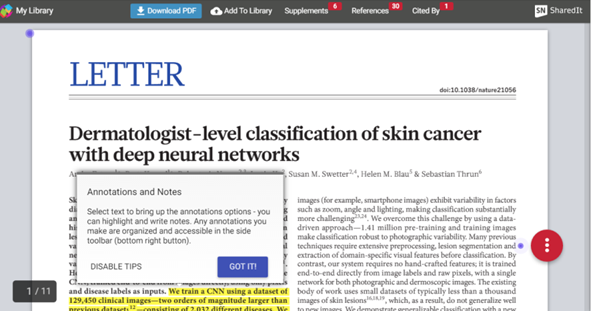
The project Springer Nature submitted to the Awards is SharedIt. SharedIt is a content-sharing initiative that provides links to view-only, full-text subscription research articles which can be posted anywhere - including on social media platforms, author websites and in institutional repositories – allowing researchers to share research, legally and freely, with colleagues and general audiences.

Tell us more about how it works and the team behind it


SharedIt uses technology provided by ReadCube, part of DigitalScience, to create a readable PDF version of the published paper – but one that cannot be downloaded – and creates a unique ‘SharedIt’ link which authors, and subscribers, can then forward on to other researchers.


Why do you think it demonstrates publishing innovation?


SharedIt is the first initiative by a global STM publisher to encourage authors to promote and use a free sharing facility – meaning anyone can access the published version of record if they have the SharedIt link. By not limiting the amount of times a paper can be shared this increases access to the published literature across the globe and through our own analysis we see many students and post-docs taking advantage of this sharing facility. Authors are also encouraged to share their links on social networking sites knowing that the research community will always have access to the final published version of record.


What are you plans for the future?


We plan to continue developing SharedIt and are currently trialling the use of sharing for books and book chapters. We are also looking into the use of SharedIt for our peer reviewer community. We are keen to listen to the community and expand SharedIt based on their needs and expectations around content sharing.

Sarah Greaves, PhD, is an experienced science publisher at the cutting edge of innovation and product development - having led successful journal launches and numerous other profitable projects in both traditional and new business models. During 18 years at Nature Publishing Group and now Springer Nature, Sarah has moved from being an editor at Nature Cell Biology, to the Nature publishing team; becoming the Nature publisher in 2007.


Since 2010 Sarah has focussed exclusively on innovation and new product launches and drove the launch of open access titles across Nature Publishing Group and has recently launched Recommended, a primary paper pan-publisher recommendation service across the Springer Nature platforms as well as helping to lead the SharedIt initiative.

www.springernature.com/sharedit
https://twitter.com/SpringerNature

See the ALPSP Awards for Innovation in Publishing Finalists lightning sessions at our Annual Conference on 13-15 September, where the winners will be announced. 

The ALPSP Awards for Innovation in Publishing 2017 are sponsored by MPS Ltd.


Wednesday, 16 August 2017

Spotlight on Publons - shortlisted for the 2017 ALPSP Awards for Innovation in Publishing


On the 14th of September we will be anouncing the winner of the 2017 ALPSP Awards for Innovation in Publishing, sponsored by MPS Limited at the 10th Anniversary ALPSP Conference.  In this series of posts leading up to the Awards ceremony we meet our six finalists and get to know a bit more about them.  

logo Publons

First up, we speak to Andrew Preston, Co-Founder and Managing Director of Publons


Tell us a bit about your company

Publons is the home of peer review. Our cross-publisher platform collects peer review activity, providing researchers with a verified record of all of their reviewing contributions. Publons makes it possible to:

     Recognise the contributions of reviewers worldwide
     Improve and expand the reviewer pool through our free online training course
     Gain novel insights into global peer review and researcher behaviour
     Find, screen, contract, and motivate reviewers (an important part of an editor's job)

All of these threads feed into our mission to speed up research through the power of peer review.


What is the project that you submitted for the Awards?

We submitted the Publons reviewer recognition service. This is essentially what you find on Publons.com and comprises of a free offering for researchers and a paid service for publishers.


Tell us more about how it works and the team behind it

Researchers sign up to create a free account. Publons then makes it really easy to import, verify, and store a record of every peer review they've performed and every manuscript they've handled as an editor, across any journal in the world. Researchers also have access to personal statistics and a downloadable, verified review record, which provides evidence of their service and standing in their field.

Records can be added regardless of whether the manuscript goes on to be published. Publons works with researchers and journals to set policies about what information can be displayed publicly. We support all review policies, ranging from completely open to double-blind, and we also enable post-publication review.


Partner journals are able to add Publons to their peer review workflow. Every time a researcher reviews for one of our 1,350 partner journals they are able to opt in to have their review seamlessly added to their Publons record. Researchers love this, making it really easy for a publisher to provide an enhanced service to reviewers.


Why do you think it demonstrates publishing innovation?

Peer review is at the heart of the research ecosystem. We rely on it to validate findings, evaluate their importance, and to flag issues in the publication. When peer review suffers, so does the quality, pace, and public perception of research.

Publons is the first platform to bring some transparency to the peer review process. It took significant technical innovation to develop the infrastructure to handle the peer review policy and editorial management system for really any journal in the world. The scale of uptake -- 180,000 reviewers and 1,350 journals from many of the top publishers in the world -- highlights the importance of the market need we're filling.


What are you plans for the future?

Publons was recently acquired by Clarivate Analytics. Together, as a trusted neutral player in the market, we believe we can tackle the challenge of bringing trust and efficiency to peer review at scale. We plan to expand our offering to make it even easier for researchers to get recognition for their work and for publishers to have a deeper understanding of researcher workload and expertise.

Right now though we are preparing for Peer Review Week - a global event celebrating the essential role that peer review plays in maintaining scientific quality and looking forward to finding out who the winners of the Publons Peer Review Awards are too.


Publons Co-Founders - Andrew Preston (right) & Daniel Johnston
 Photo by: Image Service,Victoria University of  Wellington
Andrew Preston is the co-founder and Managing Director of Publons. He was an active researcher in physics, first as a PhD student at Victoria University of Wellington, then as postdoctoral researcher at Boston University. He founded Publons with a mission to speed up research by improving peer review. Publons recognises reviewers for their work and -- with more than 170,000 researchers and over 1,350 partner journals -- is the world’s largest peer review platform. Publons was acquired by Clarivate Analytics in June 2017. 

Website: www.publons.com

Twitter: @arhpreston @publons  
Facebook: facebook.com/publons
Publons: https://publons.com/author/1/andrew-preston
LinkedIn: http://nz.linkedin.com/in/arhpreston/


See the ALPSP Awards for Innovation in Publishing Finalists lightning sessions at our Annual Conference on 13-15 September, where the winners will be announced. 

The ALPSP Awards for Innovation in Publishing 2017 are sponsored by MPS Ltd.