
Showing posts with label Springer. Show all posts

Tuesday, 5 September 2017

Spotlight on Springer Nature SharedIt - shortlisted for the 2017 ALPSP Awards for Innovation in Publishing

In this blog we talk to Sarah Greaves of Springer Nature about their shortlisted entry to tell us the story behind SharedIt.


Tell us a bit about your company

Springer Nature was formed through the merger of Nature Publishing Group, Palgrave Macmillan, Macmillan Education and Springer Science+Business Media in 2015. It is a leading global research, educational and professional publisher, home to an array of respected and trusted brands providing quality content through a range of innovative products and services. The company numbers almost 13,000 staff in over 50 countries.

Our brands are some of the most trusted and respected in their fields, with Springer founded by Julius Springer in 1842, Nature first published in 1869 and Macmillan Education a leading publisher for over 150 years.

What is the project that you submitted for the Awards?


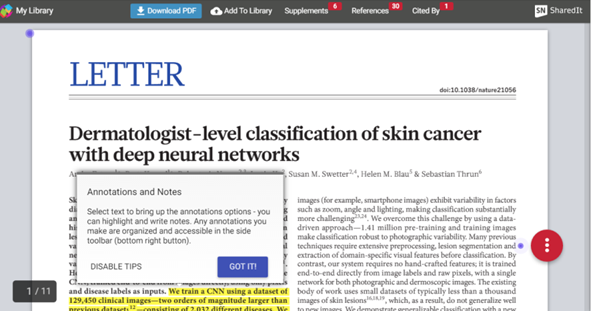
The project Springer Nature submitted to the Awards is SharedIt. SharedIt is a content-sharing initiative that provides links to view-only, full-text subscription research articles which can be posted anywhere - including on social media platforms, author websites and in institutional repositories – allowing researchers to share research, legally and freely, with colleagues and general audiences.

Tell us more about how it works and the team behind it


SharedIt uses technology provided by ReadCube, part of DigitalScience, to create a readable PDF version of the published paper – but one that cannot be downloaded – and creates a unique ‘SharedIt’ link which authors, and subscribers, can then forward on to other researchers.


Why do you think it demonstrates publishing innovation?


SharedIt is the first initiative by a global STM publisher to encourage authors to promote and use a free sharing facility – meaning anyone can access the published version of record if they have the SharedIt link. By not limiting the amount of times a paper can be shared this increases access to the published literature across the globe and through our own analysis we see many students and post-docs taking advantage of this sharing facility. Authors are also encouraged to share their links on social networking sites knowing that the research community will always have access to the final published version of record.


What are you plans for the future?


We plan to continue developing SharedIt and are currently trialling the use of sharing for books and book chapters. We are also looking into the use of SharedIt for our peer reviewer community. We are keen to listen to the community and expand SharedIt based on their needs and expectations around content sharing.

Sarah Greaves, PhD, is an experienced science publisher at the cutting edge of innovation and product development - having led successful journal launches and numerous other profitable projects in both traditional and new business models. During 18 years at Nature Publishing Group and now Springer Nature, Sarah has moved from being an editor at Nature Cell Biology, to the Nature publishing team; becoming the Nature publisher in 2007.


Since 2010 Sarah has focussed exclusively on innovation and new product launches and drove the launch of open access titles across Nature Publishing Group and has recently launched Recommended, a primary paper pan-publisher recommendation service across the Springer Nature platforms as well as helping to lead the SharedIt initiative.

www.springernature.com/sharedit
https://twitter.com/SpringerNature

See the ALPSP Awards for Innovation in Publishing Finalists lightning sessions at our Annual Conference on 13-15 September, where the winners will be announced. 

The ALPSP Awards for Innovation in Publishing 2017 are sponsored by MPS Ltd.


Monday, 17 August 2015

ALPSP Awards Spotlight on… Bookmetrix from Altmetric and Springer

Martijn Roelandse
In the fifth of the ALPSP Awards for Innovation in Publishing finalists' posts Martijn Roelandse Springer's Manager for Publishing Innovation and Euan Adie, Founder of Altmetric and fellow co-developer of Bookmetrix, talk about how they worked to launch the product.

Tell us a bit about both companies and how this collaboration came about.

As a large publisher of STM content, with a current catalogue of over 194,000 books, Springer is always keen to offer further services for our authors and editors - in particular in relation to the insight into the attention, use and impact of their titles.

Altmetric are a data science company based in London. Founded in 2011, Altmetric made it their mission to track and analyse the online activity around scholarly literature, and today supply data via their distinctive ‘donut’ badges and platforms to many of the world’s leading publishers, funders and institutions.

Euan Adie
The idea for this project was originally conceived at Springer, who wanted to find new ways to offer added value and additional feedback to the authors and readers of their extensive book content.

In addition, Springer also wanted to offer their editorial and marketing teams an easier way of tracking the reach and impact of their publishing portfolio, and were keen to offer further insight than download and citation counts alone would be able to provide.

Having first established a relationship Altmetric in 2011 with the adoption of the Altmetric API for all of their journal articles, Springer were familiar with the Altmetric team and felt there would be a shared approach and understanding of what the project was trying to achieve.


What is the project that you submitted for the Awards?

We submitted Bookmetrix - the first platform of its kind to help authors, editors, publishers and readers to track the broader impacts of a book or chapter once it’s published. The project encompassed two parts; public-facing details pages, which are now accessible via the metrics displayed on every SpringerLink book page, and the Bookmetrix search interface - a database which Springer staff can use to browse and filter the metrics across their book portfolio.


Tell us more about how it works and the team behind it.

Bookmetrix was built as a partnership between Altmetric and Springer - regular meetings between the two groups (comprising project leaders, product managers, and developers) ensured that we agreed goals and concept early on. The aim was to offer authors and readers a totally new way to see and understand the impact of their work and to help set a new standard for monitoring and reporting the activity surrounding a book post publication. To achieve this, we worked to pull in mentions and other online activity relating to each book or chapter from a variety of different sources - including downloads, citations, book reviews, public policy, mainstream media coverage and social media shares.

The data was then surfaced via the details pages - where users can see a summary of the mentions of the whole book, and dig down to view the mentions for each chapter and the original comments from each source. The details pages can be accessed via the SpringerLink platform and via the search interface (by Springer staff).

Why do you think it demonstrates publishing innovation?

Bookmetrix is the first platform of it’s kind to bring together such a valuable mixture of traditional and non-traditional indicators of broader impact and influence for books and individual chapters. Such measures are increasingly important for authors who are asked by funders or institutional management to demonstrate the influence of their work - and are particularly valuable for those who do not chose to publish journal articles (which often bring the most credit) as their main form of research output.

As well as offering this additional insight, Bookmetrix has demonstrated the value that can be found in publishers combining their objectives with the technical and domain expertise of an external partner.

What are your plans for the future?

The scope of Bookmetrix is wider than existing initiatives in the market: it covers substantially more books and goes beyond pure citation data. Bookmetrix fits in Springer’s ambition to drive more industry-wide initiatives to support the work of authors and researchers.


The winner of the ALPSP Awards for Innovation in Publishing, sponsored by Publishing Technology, will be announced at the ALPSP Conference. Book now to secure your place.

Tuesday, 16 June 2015

What is involved in providing learning solutions?

Fiona Done, Pearson Education
The publisher panel at the Personalised Learning and Publishing Partnerships seminar included three companies with three different stories to tell on providing learning solutions for HE.

Fiona Done, Learning Solutions Manager at Pearson Education, reflected on students entering tertiary education with much higher expectations of value and institution who are focusing on effective learner engagement to improve National Student Survey scores, recruitment and retention.

Pearson as a publisher is focusing more on how to work with institutions, libraries and learners so they are more effective learners. They are delivering learning to over 43,000 students using content that has been commissioned to be more digital and flexible. Their focus is now on working with the institution and the learner to come up with a personalised model with course materials whose effectiveness can be measured.

The student in 2015 is a different type of person to previous years. They are a consumer with a level of expectation of what education should deliver for them. They expect digital content that is mobile and accessible any time. Personalised learning materials are matched exactly to course content and the efficacy is measured on the individual's learning. Challenges for HE institutions include getting engaging and valuable content into the hands of students, understand where and how to source content they need, move from print to blended learning, and support required.

Kiren Shoman, Executive Director for Editorial at SAGE, outlined how they have recently developed and launched a new track in their programme: SAGE Video. She explained how three subject collections were developed with original and licensed video content.

Kiren Shoman, SAGE
Why video? It's responding to developments in higher education. The market demands it with changing student expectations. There's a strategic fit with the area they call 'publishing as you don't know it' and adding value on their existing expertise.

Video can provide a different perspective. It can help reclaim lapsed attention, illustrate a point, change the dynamic in a lecture. It can be used to illustrate a point, instruct on practical skills and inspire curiosity. It can also encourage more reading and instruct on practical skills. They built up a series of student use cases which showed they needed to engage in a multitude of different levels.

Every year on Facebook, in just one day, there are 500 years worth of YouTube videos being watched. 

They found 79% of students voluntarily watch videos to enhance their understanding of a topic. Their preferred video length range from 5 to twenty minutes. Students are hesitant to use library video resources for fear they could be outdated.

They focused on quality, content and discoverability (they use DOIs on all their video content). Their product proposition is quality over quantity. Less is more. They support reference, research and pedagogical needs. Developed with author, editor and society networks. Resulted in launch of Counselling & Psychotherapy, Education and Media & Communication collections. Plan to launch 2016 Collections in six other core areas in 2016. Their content value is around expertise of SAGE, curricula matching, pedagogical focus, stability and a global view.

Their content strategy was two pronged. Part 1: work with authors and academic societies. Part 2: partner with the right content providers such as TV sector. They have branded original production including shorts, expert interviews, lectures, cases, tutor and in practice.

The platform has focused on user needs. They have social sharing tools, embedding and favourites that can all help you build up your own profile. They have speed tools to adapt to different viewer pace. So far, the feedback has been good. Any learning will be fed into the next few collections. You can view the short promotional video here.

Tom Spicer, Springer
Finally, Tom Spicer, Senior Editor at Springer, discussed how they have worked to support Massive Online Open Courses (MOOCs) instructors, book authors registered students, institutions and societies by offering a tailored approach.

MOOCs offer a mass and unlimited participation online learning and teaching environment. They can include traditional course material, videos, problem sets, readings, assessment and interactive user forums. the core principle is that it is freely available. Typically you pay at the end if you want to get a certificate.

Why do a MOOC? For a university, it is primarily about promotion as a home of exceptional teaching in order to increase the number of international on-campus students. It also helps develop new forms of teaching and learning. It can also generate data for research in education and assist with international networking.

The challenges are financial: costs are significant and there isn't really any business model. There's an accreditation problem, course completion rates are very low (typically less than 10%) as well as student authentication and logistics. MOOCs have a checkered history. They have a sometimes justifiable credibility issue. However, that is changing. There are now several hundred serious UG/PG MOOCs being offered.

Springer has been testing the water in several ways, one of which is by providing MOOC organisers with an access controlled URL that leads to the selected ebook. They have seen an increase in sales as a result spread across the period of the MOOC. They set up a reciprocal agreement with the institution and see MOOCs as potential new markets for existing products, but also as a source of new textbook content and new learning and teaching models.

Springer in Germany has piloted enhanced ebooks for MOOCs and Springer Spektrum has piloted distance learning courses. Springer Healthcare are delivering 'corporate' MOOCs which include smaller sets of content for communities in the field.

Friday, 12 September 2014

Open access: the daily challenge (new customers, processes and relationships)

Phil Hurst, Jackie Jones, Wim van der Stelt
Springer's Wim van der Stelt chaired the final panel at the 2014 ALPSP International Conference. The panellists reflected on the daily challenges of starting an open access product and how the new business model fundamentally alters the publication chain.

Phil Hurst from the Royal Society talked about how they approached launching OA journals. They had a gap in their portfolio and they thought the best way to do this was to launch an OA journal. Open Biology was their first online only journal.

They learnt that many things are the same. Getting the right people on the board is key: you need top people. Content is still king and they need to get the journal in the right places. Open access is a big benefit to everyone. They didn't really realise until they launched the journal. The benefits to stakeholders include speeding up science. There is greater visibility for universities and funders. For researchers there is increased visibility and results. It was good for them to get involved in the OA community.

Much of the marketing is the same, but they supplemented this with an OA membership. Authors from member institutions receive a discount on pure or hybrid access. They incorporated a wider range of metrics including DORA and Altmetrics as a range of measures of research impact. It has also provided them with a springboard. They launched the journal to learn and prepare for the future. OA is consistent with the mission of learned societies. Sustainable? The jury is still out, we will only learn by putting OA journals to the test.

Alex Christoforou from BioMed Central asked who is the actual customer for an OA publisher? They have hundreds of journals across BMC and Springer with hundreds of members, thousands of authors and transactions. What they all need is access to the publisher, support and excellent customer service.

Alex Christoforou
They continue to provide some good old fashioned and reassuring tools to support authors such as a fax number, photos of the team on the web and lots of different ways to contact them. They have 4000 customer service queries each quarter that they deal with. It's increasing as well. They have to provide some kind of service 24 hours a day so they can turn around queries in one day. They even provide online banking for those that spend large amounts of money.

Customer services is not just complaints, payments and author services. It's a way of thinking across the organisation so that all stakeholder groups can build a constructive relationship with them and business can grow over time.

Jackie Jones from Wiley talked about subscription versus open access and 'flipping' journals. They have flipped eight journals so far and it is early days. Some of the key flip criteria they assess include
whether it has a modest subscription revenue. Typically these are young journals that haven't achieved predicted revenues. They also look at areas where there is evidence of good OA funding and existing hybrid activity. Where there is longer term growth potential or attractiveness to authors. They also consider ratio of current revenue to articles.

For publishers flipping can lead to potential for faster growth, but there is higher volatility of revenues. From a society perspective, it provides an opportunity to explore OA. However there is risk commercially and editorially. From the funder point of view some prefer full OA journals but Gold OA is the only option. From an institutional point of view there is no subs fee, but you have to track APCs and costs. For tools and modelling they have flow charts and decision trees to help monitor and track submissions and revenues.

EMBO Molecular Medicine launched in 2009. It had modest subscription sales and the society had concerns about visibility. There was an 85% rejection rate. The per page publication charge was 125 euros and pre-flip the average author cost was 1600 euros. They set the APC at 3000 euros in line with other journals in the society's portfolio. Submissions doubled in the launch period. However, on other journals there was a dip in submissions initially, but they do recover.

They have learnt you need to plan ahead and time communication really carefully. Make sure papers in hand are under the new model so you don't have to waive fees. Don't flip mid year and avoid complications of subs reimbursements. Undertake submissions and publications surveys.

Thursday, 13 September 2012

ALPSP Conference Day 3: Giving away the farm


'Giving away the farm' was the penultimate session from this morning's programme. Chaired by Catherine Candea from OECD, the panel reflect on the pressure scholarly publishers are under to give away content. 

With six month embargoes being demanded and some publishers moving fully to giving away their output as soon as it’s published, what effect is this going to have on the industry?

Wim van der Stelt from Springer provided an relatively upbeat assessment of where they are at. It’s good that the Finch group recommended the gold OA route and acknowledged that content needs to be paid for. Meanwhile, Europe, as always, took the wrong decision and have come down on the side of green with a 6 months embargo or gold, but with the funding still insecure. 

Springer pioneered the hybrid journal and now have price adjustments for selected hybrid journals every year. They moved into real/full open access when they bought BioMed Central in 2008. Not only did it provide them with an open access portfolio, but also helped their systems and processes to be author oriented. Most importantly, they bought in the new culture enabling them to shift from legacy culture. Oh, and it also makes money.

Springer Open now has over 405 members in 46 countries. Their Open Access journals are in all area including economics, social sciences, humanities, etc and 15% of all their articles are already open access. Springer Open now includes books! 

His advice to publishers on what they can do included:
  • provide hybrid option
  • start full open access
  • transfer subscription journals to open access
  • look at sister journals
  • sponsored journals
  • new journals
  • be creative with financial models for society journals
But don’t forget... open access is just a business model so keep on providing the service of validation, structuring and dissemination and don’t forget to develop new services.

Jose de Buerba from the World Bank took us through their transition from charging for publications to making everything free. They are the largest Development Agency worldwide with $35.2 billions in projects approved during FY12. With 10,000+ staff and 120 field offices (mostly in developing countries) their annual publishing outputs in 2011 were: 367 journal articles (75% published externally), 438 working papers, 146 books, 500+ other pieces of analytical work very diverse subjects.

The World Bank mission is to help generate a world free of poverty, but their conflict was between: mission or money. They have embraced green OA so they can be open about what they know (data and knowledge), what they do (operations and results), about how they work (partnerships for openness), and have open government (transparency, accountability).

This video puts it neatly:


The new currency is for development impact and their Open Knowledge Repository has had 140,000 downloads since September. The business model comprises: budget from the institution, publishing service fee, revenues from commercial activity from value added products.

Xavier Cazin from Immateriel.fr considered paid content vs paid comfort. They are one of the four ebook distributors in France. Distribution is still pertinent for their ebook market and it involves seeing all kinds of publishing offers based on the same content.

The certainties of print costs have gone and with digital content it has become difficult to understand what people are expecting on pricing. One trend they’ve seen as a distributor is that of people making a business out of refurbishing public domain content. Why does it sell? And why at that price?

He considered what customers are willing to pay for: 
  • ease of access (where they are now)
  • handy (readable with my current device/app)
  • easy navigation through the content
And what are the reading rewards? A rich and well designed environment, content/curation appropriate to current needs and sharing functionalities. In his view, the product unit price should work to equation of ease of access + reading rewards = value. For the reader, content quality + authors reputation = content reputation. Based on this, the total revenue should be: product unit price x number of customers/readers with the former related to reading comfort and the latter to content reputation.

For anyone not clear on definitions of OA there’s an overview on wikipedia http://en.wikipedia.org/wiki/Open_access