Showing posts with label authors. Show all posts

Wednesday, 25 July 2018

Brand Building the Scholarly Author – So what’s in it for the Publisher?

In this week’s guest post we hear from Jean Dawson, Product Manager at Charlesworth Author Services and member of ALPSP’s Professional Development Committee behind ALPSP programme of webinars.


It has never been more topical to develop academic authorship as a ‘brand’; this has been particularly emphasised by educational institutions that now often provide training sessions for their Early Career Researchers (ECRs, including PhD and Master’s students). These courses enable ECRs to understand how to build their online presence and the importance of starting to think of themselves as a ‘brand’ very early in their careers. Professor Stephen Hawking, for example, was not only an academic he was a ‘brand’, as are the TV personalities Dr Alice Roberts and Dr Brian Cox.  Although it is clear that not every academic can reach the same pinnacle of ‘brand’ as Professor Stephen Hawking, they can nevertheless be taught how best to present both themselves and their research to the online community effectively.  I have attended sessions at universities where ECRs have been tutored on how to write and present their LinkedIn profiles as a part of their extended curriculum vitae, create online social profiles, were reminded that prospective employers can search for you on Facebook, were given guidelines on how much of their research to reveal online (and where, as ‘online’ is a big place) and on which online communities to associate with. All vital life tools to assist in publicising your research at an early stage, job searches, promotions, and publishing contracts.

Advancements in technology platforms provide tools that directly assist academics to build their online profiles, understanding where their work is being read and cited, as well as how to build an ‘audience’ for their work. These platforms also encourage authors to be proactive in their research dissemination, rather than just passively waiting for citations. They shout ‘Get out there and sell yourself!’ As Charlie Rapple (co-founder of Kudos) will be pointing out in her presentation in ‘Brand Building the Scholarly Author’ ALPSP webinar, given an annual research investment of over £1 trillion by funders, and with over 2 million outputs published, it’s simply staggering to note that up to 50% of these outputs will never be discovered. No-one reads them, let along cites them.  Funding bodies have woken up to this huge issue and are looking to see activities that drive engagement with research. This puts the ball squarely back into the academics’ court.

So what is the knock-on effect for academic publishers? To paraphrase Cathy Holland (Business Development Manager, Digital Science), the second speaker on the ‘Brand Building the Scholarly Author’ webinar, “Social media has a huge impact on the way information is communicated today… No longer can the publisher or author passively just sit back and let content collect citations.” In the same way as authors now need to become active, publishers also need to be actively engaging online with scholarly research communities. Engaging is not enough and publishers must also now measure their social media efforts to successfully access their reach and effectiveness. As we have seen with the new social-media tool kits for authors to emerge, technology platforms provide Publishers with key measurement and online engagement tools.


Jean Dawson is the Product Manager at Charlesworth Author Services. Jean has over 25 years’ experience in senior management roles in publishing across the industry from academic publishing, start-ups, to publishing service providers. Commencing her career at Oxford University Press, she moved to form part of the Ingram UK Business start-up team. Prior to joining The Charlesworth Group, Jean worked as a consultant providing product development and marketing services to trade and academic publishers. Jean is also an active participant in cross industry membership groups.

The Brand Building the Scholarly Author seminar will take place on Thursday 18th October 2018. To find our more or to book your place visit: https://www.alpsp.org/Webinars/Brand-Building-the-Scholarly-Author/56883


Friday, 6 July 2018

How to train your author - Is author training a good idea for publishers?

In this week’s guest post, we hear from Dr Gareth Dyke who heads up Charlesworth Knowledge, a new service being launched this year for authors, educational institutions, and publishers.


A huge range of training courses, most often delivered online, are available to help academic researchers improve their writing and publication presentation skills. I’ve often wondered, however, if encouraging authors to attend such courses and improve their abilities (albeit incrementally) is actually a good idea for publishers? There is an argument that it is in the interests of the publication house to receive badly written content so that in-house editing and polishing offerings can be recommended, leading to an obvious knock-on increase in revenue, in spite of the editorial headaches involved in reviewing them.

This feedback loop seems self-defeating for publishing houses. Surely once an author has been trained to write better and more effective articles, then that individual is less likely to avail of in-house language editing services?

I disagree. I’d argue that the whole author-publisher ecosystem should be viewed pragmatically and is, after all, a question of scale. What does a publisher gain from training authors to write better on their own? In addition to reducing the time spent working over the hundreds of submissions that might come through a system week on week, revenue from providing the training itself is important. Looking longer term: better quality submissions enhance the journal, building its reputation, leading to more citations, raising up the impact factor, and driving subscriptions. In this day and age of quick online publications that are often open access amidst competition for your readers' time (even within your own research field), well written and effective articles that draw readers in and keep them going past just the title and the abstract are a bonus for everybody. It’s also important to build loyalty amongst authors so that they keep submitting their papers to the same journals; this could be because this is where they received their key training, as well as the reputation and quality of the journal playing a role in their decision. This is one good reason why the big academic journal publishing houses offer author training, often as standalone ‘academy’-type model or pay-per-view online workshops and seminars; they want to encourage author submission habits with quality product that all feeds into driving up their sales, including insitutional subscriptions, and publisher/journal reputation. 

So, yes, author training is a very good thing. Perhaps that’s why more and more publishing houses are getting into this area and offering these courses either directly or through third-party training providers. Through the many years of providing high-quality language polishing services, Charlesworth Author Services has recognised this growing need to provide high-quality and high-value training to the academic authors who use our services. Author education provided by the unique combination of people with both publishing and reviewing skills at the highest level is the logical next step.

About The Charlesworth Group


With close to 20 years' experience in China, The Charlesworth Group is recognized globally as the trusted partner for sales and marketing representation and consultancy for STM publishers in the Chinese academic market. Charlesworth is also a leading provider of language editing and author services through its Charlesworth Author Services Division.


Dr. Gareth Dyke


Gareth is a prolific scientific author who has published more than 200 articles in peer-reviewed journals over the last 20 years. During Gareth’s experience as an academic, working across multiple Universities,  he has mentored students at all ages and has developed a large range of teaching techniques.

Website: www.cwauthors.com
Twitter: @CWGAuthors
Linkedin: Charlesworth Author Services
Facebook: www.facebook.com/CWGauthorservices


Tuesday, 5 September 2017

Spotlight on Springer Nature SharedIt - shortlisted for the 2017 ALPSP Awards for Innovation in Publishing

In this blog we talk to Sarah Greaves of Springer Nature about their shortlisted entry to tell us the story behind SharedIt.


Tell us a bit about your company

Springer Nature was formed through the merger of Nature Publishing Group, Palgrave Macmillan, Macmillan Education and Springer Science+Business Media in 2015. It is a leading global research, educational and professional publisher, home to an array of respected and trusted brands providing quality content through a range of innovative products and services. The company numbers almost 13,000 staff in over 50 countries.

Our brands are some of the most trusted and respected in their fields, with Springer founded by Julius Springer in 1842, Nature first published in 1869 and Macmillan Education a leading publisher for over 150 years.

What is the project that you submitted for the Awards?


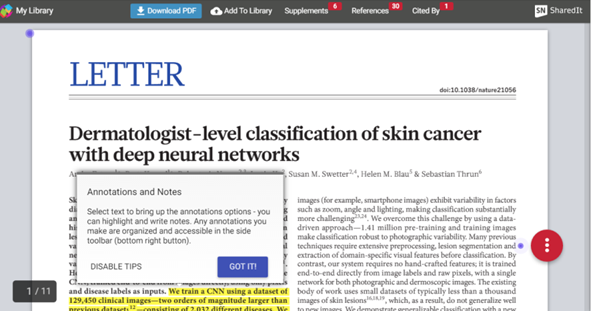
The project Springer Nature submitted to the Awards is SharedIt. SharedIt is a content-sharing initiative that provides links to view-only, full-text subscription research articles which can be posted anywhere - including on social media platforms, author websites and in institutional repositories – allowing researchers to share research, legally and freely, with colleagues and general audiences.

Tell us more about how it works and the team behind it


SharedIt uses technology provided by ReadCube, part of DigitalScience, to create a readable PDF version of the published paper – but one that cannot be downloaded – and creates a unique ‘SharedIt’ link which authors, and subscribers, can then forward on to other researchers.


Why do you think it demonstrates publishing innovation?


SharedIt is the first initiative by a global STM publisher to encourage authors to promote and use a free sharing facility – meaning anyone can access the published version of record if they have the SharedIt link. By not limiting the amount of times a paper can be shared this increases access to the published literature across the globe and through our own analysis we see many students and post-docs taking advantage of this sharing facility. Authors are also encouraged to share their links on social networking sites knowing that the research community will always have access to the final published version of record.


What are you plans for the future?


We plan to continue developing SharedIt and are currently trialling the use of sharing for books and book chapters. We are also looking into the use of SharedIt for our peer reviewer community. We are keen to listen to the community and expand SharedIt based on their needs and expectations around content sharing.

Sarah Greaves, PhD, is an experienced science publisher at the cutting edge of innovation and product development - having led successful journal launches and numerous other profitable projects in both traditional and new business models. During 18 years at Nature Publishing Group and now Springer Nature, Sarah has moved from being an editor at Nature Cell Biology, to the Nature publishing team; becoming the Nature publisher in 2007.


Since 2010 Sarah has focussed exclusively on innovation and new product launches and drove the launch of open access titles across Nature Publishing Group and has recently launched Recommended, a primary paper pan-publisher recommendation service across the Springer Nature platforms as well as helping to lead the SharedIt initiative.

www.springernature.com/sharedit
https://twitter.com/SpringerNature

See the ALPSP Awards for Innovation in Publishing Finalists lightning sessions at our Annual Conference on 13-15 September, where the winners will be announced. 

The ALPSP Awards for Innovation in Publishing 2017 are sponsored by MPS Ltd.


Thursday, 25 September 2014

What societies need to know about Creative Commons (CC) Licensing - free webinar

Want to know what a CC license is and what all the different types mean?
Which CC license is best for your journal’s authors and the future of your journal(s)?

What societies need to know about Creative Commons (CC) licensing
Tuesday, September 30th, 8-9am PDT/11am-12pm EDT/4-5pm BST

With new mandates being announced by funders globally for Open Access archiving of their funded research, societies need to understand what the different CC article licensing options mean, both for their journals’ and their members’ needs.  This webinar will provide society executives with an overview of what they need to know about CC licences. Do you know your CC BY from your CC BY-NC-ND?  What are the pros and cons of different CC licenses for society journals? What options should you give your authors?

With speakers from Creative Commons, Copyright Clearance Centre and Wiley.

To register your place, visit http://goto.copyright.com/LP=981

This webinar is organised by Wiley in conjunction with the Copyright Clearance Center

Thursday, 28 February 2013

Steve Pettifer's break-up letter: Dear Publisher...

Pettifer: with a break-up letter to the journal
Steve Pettifer, from the School of Computer Science at the University of Manchester, offered a break-up letter to the journal for the audience of Ignore Your Authors at Your Peril seminar today. Pettifer believes that there's a simple equation for his career:

Ability to do science = funding x cleverness

Likelihood of funding =
(previous ideas x prestige) + new idea

Is it about ego? Possibly. This is where scholarly communications come in. As an academic and researcher he has to convince funders that he is a good person to take an idea forward that will help change the world. When he started as a researcher, it was the end of the old style of publishing, a time when it felt weird when things started to go online.

The challenge now is that researchers operate in a landscape of goodness or importance and managing the transition from one to another without dropping your research status is tough. Every now and again, something comes along that changes the environment, that enables them to get to their goal. Open access might just be that disruptive force (for publishers) that works (for researchers).

So what are the things that publishers tell him that they do for him?
  • peer review
  • copyediting
  • typesetting
  • visibility
  • legal support.
Yet for each of these valuable services, there are poor examples that undermine the statement. A recent study into peer review demonstrated that only one third agreed on the science with one third signal to two thirds noise. That is itself not a bad thing, but it's not compelling evidence of the value and efficacy of peer review for the scientific record. (Source: Peer Review: Welch, Ivo. 12 October 2012 Referree Recommendations, Social Science Research)

Pettifer quoted Kent Anderson from a recent post on Scholarly Kitchen that asked how science can maintain integrity if papers are buried in 'mega journals' and don't have full peer review? In reality, Pettifer says, he has never cited a paper because of its peer reviewed status. He then went on to mention Alan Singleton in a recent Learned Publishing article. In it, Singleton had paraphrased feedback during peer review, as the essence of its definition. It was something along the lines of: 'the methods are OK, I don't agree with the result, so it should be published for others to repeat or test the experiment.'

Pettifer went on to discuss copyediting: it's not always great, there are numerous examples available of poor grammar in headings from great and good publications. There are some fundamental errors that are made in typesetting, for example, the confusion of German ß rather than β. These things stand out and undermine claims of a valuable, quality service to authors.

He asked publishers to be clear about the relationship between them both. Understand that sometimes it is almost impossible for authors to comply with even the most basic requirements (with ebooks or epapers, it is impossible to comply with making only one copy, as soon as you download, your devices will sync).

He asked publishers to embrace new things. He called for them to move on from the journal impact factor. Many think it is rubbish. And there are lots of other exciting things coming along that are great measures for a researcher including: Impact Story, DataONE, figshare, Altmetric, ORCID, using DOI, and Dryad, that aim to make papers more readable.

He also stated that the object of record is for machines. While he is nerdy, and it matters a lot to him, it is not for humans. Make it available for machines to reference and search.

Pettifer wants publishers to recognise he is an individual and author, reader, editor and reviewer. Help him communicate his work, and help him to make his work better. He believes that BioMedCentral has not moved on much; PLOS is still quite traditional; eLife is too, but is aiming for higher quality. PeerJ is exciting, and arXiv - while just a way to put pre-published papers online - works for physicists. PeerJ and eLife have set the bar high in technology (readability and downloadable objects) with a combination of good technology and presentation.

What do all publishers need to do? Make publishing a service, not an ordeal.

Monday, 25 February 2013

ASA 2013: Jeremy Frey on Reputation, Responsibility, Reproducability and Reuse - A Scientist's Perspective on the Role of Publications


Jeremy Frey addresses the ASA conference audience
Jeremy Frey is Professor of Physical Chemistry at the University of Southampton. He covered a scientist's perspective on the role of publications and pointed out that the open access debate is actually an issue about the economics of who pays, as someone has to. However, he believes that there are different consequences around accessibility when you consider who does.

The consequences of not having open data is that your work cannot be checked by someone as bright as you. This could be an error made in good faith. There are ways of validating data, but they are dependent on having access to the data and a willingness to host that data. In his opinion, the Royal Society report has come up with the best phrase so far: 'intelligent open access to data'. It's not just access to the data, but it's also critical to record somewhere how to get use out of the data.

Some projects need large amounts of data from the literature. Access can be an issue. A digital repository is one answer, but does this lead to subversive and furtive sharing and exploitation of data in a virtual space? Can people understand how to use it?

One of the issues is that people in the scientific community put all emphasis on the answer, not the working out. And yet the process of coming to an answer is the most important part: 'methods are as important as the data'. The BBC 'Climategate' campaign is a good example of the benefit of doing this. Even Faraday in his notebooks included a huge amount of detail about how he went about his experiments.

What are researchers trying to get out of the whole publication process? Dissemination, reputation, and advancement. The scientific information supply helix was historically from researcher to literature to abstraction/search to literature. Currently you can add open notebook science. This makes the flow go from researcher to the web(?) to search to researcher, but this is rarely the only dissemination route.
There is a need for validation, traceability and accountability for recognition, promotion and future funding.

There are some journals that would limit the number of references within article as they are constrained by page size. This is a real problem in the interdisciplinary world. However, this is shifting as online removes space restriction. 

There are a number of problems with interdisciplinary research and dissemination. The methods and emphases varies with discipline:
  • journal versus conference
  • pure versus applied
  • research versus application
  • authorship and acknowledgements
  • who goes on the paper?
  • who is mentioned in the press release?
  • do you acknowledge the technician?
  • e.g. maths is like humanities - student works on their own while science is team work.

He believes that researchers also need to reflect on how they communicate the data. The Smart Tea Project was a way to create a harness to record data as you go along, but it was a bit overbearing for students. Then they moved to LabTrove which has more of a blog style with a highly interlinked system. Other issues to consider are diversity and disability. Another example is the BlogMyData Project. This type of project has an impact on researchers, can lead to a higher quality record, easier collaboration, improved planning, better proactive interaction and can run in a completely open or closed way.

Access to the discussion and the means of reproducibility of the analysis is really important to the way the community will be working in the future. Things have to change and at pace.