Showing posts with label :#alpsp2022 #alpspawards #scholcomm #innovation #publishing. Show all posts

Friday, 19 August 2022

Spotlight on: Impact Services

This year, the judges have selected a shortlist of seven for the ALPSP Awards for Innovation in Publishing.  Each finalist will be invited to showcase their innovation to industry peers on 14 September on the opening day of the ALPSP 2022 Conference in Manchester. The winners will be announced at the Awards Dinner on Thursday 15 September.

In this series, we learn more about each of the finalists. 

Emerald Publishing logo

Tell us about your organization  

Emerald Publishing is one of the world's leading digital first publishers, commissioning, curating and showcasing research that can make a real difference. We work with thousands of universities and business schools across the world to share knowledge and provoke the kind of debate that leads to positive change. We are a family founded business, passionate about people, and doing things differently. Going beyond the bounds of a traditional publisher, we want to be a facilitator of impact, encouraging equitable, healthy and sustainable research and publishing for all.  

What is the project/product that you submitted for the Awards?  

Impact Services has been created in collaboration with academic impact experts, as well as universities and institutions in the UK and Australasia, with the aim of making ‘impact culture’ a daily reality for researchers and increasing the opportunities for research to make a difference. Alongside Emerald’s partners, we’ve created a service unique to the publishing industry which instead of focusing on the measurement and evaluation of impact, it creates a research environment conducive to producing high quality research that leads to real world change. 

Tell us a little about how it works and the team behind it  

logo impact services
Impact Services is a subscription, cloud-based service, made up of three parts: 

Impact Planner: A comprehensive planning tool, through which researchers are guided through a process to map impact pathways, engage with society and drive meaningful and measurable change. The planner is underpinned by the principles of Impact Literacy, navigating researchers through the processes of identifying need, articulating impact goals, identifying stakeholders and considering barriers to generate an overall plan.  

Impact Skills: Developed and created with our academic partners, Impact Skills is a set of learning materials to build impact competencies across the research ecosystem. The content reflects academic insights into the skills and the framework needed for building impact literacy, and specific content has been commissioned from key members of the research community, augmented by existing, relevant content from our online learning platform sister company, Mindtools. Coupled with and accessible from the impact planner – provides a rounded service in support of impact literacy planning and action.   

Impact Healthcheck: In parallel with the more individually focused Planner and Skills aspects, this section focuses on institutional practices and how to build ‘healthy’ approaches to impact. Our academic collaborators have identified how the pressures to deliver impact within the research sector risk unhealthy and non-inclusive practices, and this Healthcheck provides institutions with a diagnostic tool to understand what they are doing well and what areas they might want to focus on.  

Impact Services was based on the research and experience of Dr Julie Bayley and Dr David Phipps, both experts in the field of research impact. Alongside Emerald and Mindtools (an online learning company part of the Emerald Group), there were workshops with researchers and the research office, the commissioning of authors in the research environment and finally the digital development team to create the service. Now, Impact Services is worked on by a dedicated team at Emerald with expertise in UX, sales operations, customer operations, marketing, and publishing. We regularly action on feedback from our customers, and Dr Bayley and Dr Phipps, to ensure the service satisfies the appetite of the research community. 

In what ways do you think it demonstrates innovation?  

The significance and innovation of Impact Services is threefold.  

Firstly, the suite of tools focuses on the development of healthy, literate practices based on the expert knowledge of those who support impact on a daily basis. Where many tools in the sector focus on measurement or capturing evidence of impact, Impact Services uniquely seeks to equip individuals with the means to build their own literacy and address practices of their work environment to maximise the likelihood of impact.   

Secondly, Impact Services represents a significant step change in the publishing sector, taking an end-to-end approach to impact from the inception of a research idea through to actual societal change, rather than solely focusing on better communication and dissemination of research outputs.   

Thirdly, the principles underpinning Impact Services have been embedded across Emerald’s business as a whole. Emerald updated its Impact Manifesto in 2022, is a signatory of DORA, and has since co-funded additional research to understand challenges around impact literacy in the funding application process. Impact Services will continue to evolve and refresh in line with the sector’s need.  

What are your plans for the future?  

We want to continue to support changes in research evaluation, showcase the stories of new approaches, and work to advocate healthy approaches to research impact.   

Through Impact Services, Emerald is supporting the need for a service which helps to plan for impact to enable stronger research outcomes. It helps to de-mystifying impact and to provide a structured way for research to lead to real change in the world. Emerald has an active roadmap and ensures new features are prioritised based on customer feedback and demand. We have always solicited regular and comprehensive feedback from customers and prospective users and want to ensure that we reward their time and honesty with the right improvements to the service. For example, we are scoping enhancements to the collaborative functionality of the service.  

About the author

photo Steve LodgeSteve Lodge is Head of Services for Emerald Publishing.  He has worked for the business for almost ten years, most recently looking at ways in which they can support research staff in developing their impact literacy; the ability to understand, appraise and make decisions on how research resonates with the outside world.

.

Spotlight on: Hum

This year, the judges have selected a shortlist of seven for the ALPSP Awards for Innovation in Publishing.  Each finalist will be invited to showcase their innovation to industry peers on 14 September on the opening day of the ALPSP 2022 Conference in Manchester.

In this series, we learn more about each of the finalists. The winners will be announced at the Awards Dinner on Thursday 15 September. 

Hum logo

Tell us about your organization

There are about 20 of us at Hum, and we are a fully remote organization. The idea of Hum developed from Silverchair’s product innovation function. We were set up as a separate company in late 2021 so that we could single-mindedly pursue an idea that we think has the potential to transform publishing.

What is the project/product that you submitted for the Awards?

Hum is the product, as well as the company name. One of the challenges we face in talking about Hum is that there is a lot about it that is new and different. As a class of software, Hum is a ‘Customer Data Platform’ (or CDP), but for most publishers that isn’t that helpful a place to start since they aren’t that familiar with CDPs – although they are going to get familiar with them because my view is that every publisher (and society) will have a CDP as a central part of their tech stacks and – more importantly –business practices, within 5 years.
So what do CDPs do? They integrate with the other systems and databases at an organization and collect all of the relevant data about an audience (defined as everyone who comes into digital contact with that organization, covering user, reader, customer, reviewer, author, librarian, researcher, teacher, and learner, and so on) and then they allow you to manipulate that data for business use. The primary ways that organizations can use CDPs are via vastly improved segmentation and personalization. Sounds simple, but it is the means for organizations to make data-driven decisions about nearly everything they do.
At Hum, in addition to helping the publishing market to understand what CDPs are, we need to highlight Hum’s critical differentiators from the class of generic CDPs. These differentiators come from Hum’s focus as the only CDP built for content-rich organizations (publishing, most obviously).

Tell us a little about how it works and the team behind it

Hum brings together all of the first party data relating to a publisher’s audience and provides that publisher with the tools to generate insights and take actions from that data. The systems integrated with are likely to be publishing platforms, websites, CRMs, commerce systems, marketing systems, and submission and peer review systems, for example. The data is demographic (name, age, location, email, title, university, library); transactional (a purchase made, a campaign email received); and behavioural (reading all or part of a journal article, visiting a blog post, opening an email, clicking on the email content, scrolling, carrying out a search, downloading content, listening to a podcast, watching a video).

It is this final category (behavioural data) where Hum’s differentiation really kicks in. You can generate significant insight and business benefit by understanding how your audience is engaging with your content. Hum tracks at a deep level every audience member’s interaction with content, capturing what is being read, by whom, how deeply, when, etc. When this behavioural data about interests and intent is tied together with other data (eg demographic and transactional), a lot of exciting use cases become possible. But Hum does not just collect up all the data that a publisher is already capturing (and in most cases not using). It generates significant new data. Hum uses AI (and this is genuinely AI, based upon our own proprietary development of Google’s BERT) to automatically tag every piece of content at a publisher. Many publishers have their journal and book content tagged at some level, but Hum automatically tags and assigns key words to ALL content (video, podcast, blog, content marketing, social, marketing pages, etc). So Hum is generating new data about a publisher’s audience’s engagement with a publisher’s entire content set.

This focus on content is a big differentiator. But also very important is that Hum is ‘built for humans’. While Hum is powerful it is also easy to use: data-driven decision making becomes something that everyone in the publisher can do, rather than requiring data scientists.


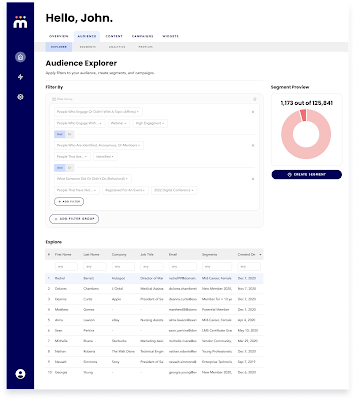
illustration graphic Hum


Hum is best understood by example. Say you want to market a new webinar. After implementing Hum, you can use Hum’s ‘Audience Explorer’ to build in a matter of seconds a precise segment that you think will be interested in that webinar. That segment of interested people will automatically be reflected in your email and advertising platforms to use for targeted messaging. The segment is live, not static: when people sign up for the webinar, they are removed.

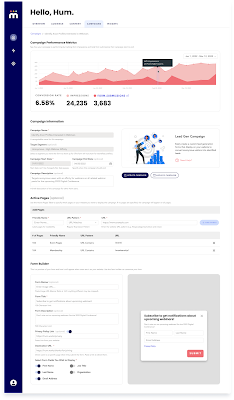
Hum illustration graphic

When new people qualify, they get targeted messages or ads. For your identified users (for whom you have an email), you can promote the webinar ‘off platform’, often via regular communications that are specifically tailored down to the individual and drive 150%+ lift in metrics like opens and click throughs. You can also target anonymous users on your own sites via popup modals, personalized ads and content recommendations (webinars are content too!). And if I had more time, I’d tell you about ‘Content Explorer’ that allows publishers to understand what content is (and is not) working, for whom, where, when, and so on, to help to devise content and product development strategies based not on guesswork but on actual audience interest and behaviour.

The biggest use cases in publishing are: improved marketing via segmentation and personalization; improved ad targeting; author and reviewer acquisition; content strategy; audience building and identification; B2B sales; and new product development. As for the team, we are a mix of technologists, publishers, data scientists, and sales, marketing, and delivery people. We joined Hum for its mission and culture.

In what ways do you think it demonstrates innovation?

Hum is the first CDP purpose-built for publishers. Publishers care a lot about their content. And so do we. Our focus on content as a first-class artifact is a key Hum differentiator amongst the broader CDP category, and it’s an area where much of our innovation is demonstrated. We’re developing a few proprietary features that help publishers evolve their content strategy and deepen their understanding of how readers interact with content.

I’ll highlight a few areas of content innovation:

- Engagement Scoring:


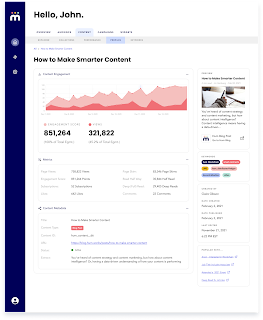
graphic illustrating engagement scoring


- Content & Audience Explorer:

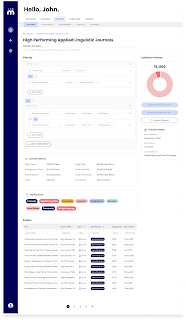
graphic content and audience explorer

What are your plans for the future?

We’re just getting started and we’ve got miles to go! We just launched in 2021 and we’re still working our way towards fully understanding what publishers need and want from the Hum product. Hum’s success and future depends on delivering genuine differentiation and business value for publishers. We’ve had great success with our early customers, but we’re always listening for their feedback as we continue to evolve the product.

Hum uses a proprietary engagement algorithm that gives publishers a sense for their best topics and subtopics by assigning values to various content metrics. It reads each piece for engagement metrics like full and partial reads, visits by segment, overall traffic, etc. It compares these article-level metrics to other pieces in the corpus to share comparative insights on content performance.

- cueBERT: A modified version of Google’s BERT pre-trained model (trained on huge amounts of text), tweaked to read content and understand what it’s about.

- cueBERT uses Natural Language Processing and machine learning to understand the entire body of content, normalize the tagging of that content, and iteratively improve Hum’s recommendations engine.

This feature pulls a lot of what I’ve just described together. It’s an interactive tool that allows you to drill down into your content and audience based on various search parameters. It lets publishers get a real-time look at important trends, answering questions like: What topics are resonating most with x group?; How big is x segment, and more importantly, how can we activate them?; Where are the gaps in our content strategy?; What are readers in x segment most engaged with? 

About the author

Tim Barton, CEO

photo Tim Barton


Tim worked for OUP for 27 years in many different rolesand markets across research, higher education, and dictionaries (in his last role, he ran OUP’s Global Academic Division) before joining Silverchair (as President) in 2018. As CEO, Tim oversees all aspects of Hum growth and operations. Tim splits his time between New York, NY, Charlottesville, VA and Oxford, UK

Relevant web links:

www.hum.works/publishers


Spotlight on: GigaByte

This year, the judges have selected a shortlist of seven for the ALPSP Awards for Innovation in Publishing.  Each finalist will be invited to showcase their innovation to industry peers on 14 September on the opening day of the ALPSP 2022 Conference in Manchester. The winners will be announced at the Awards Dinner on Thursday 15 September.

In this series, we learn more about each of the finalists. 

Gigabyte logo


Tell us about your organization

GigaScience Press is an Open Access Publisher, based in Hong Kong, that publishes journal articles and accompanying datasets and software. It is a division of BGI Research, a non-profit research institute that is part of the genomics organisation BGI-Group.


graphic gigabyte


What is the project/product that you submitted for the Awards?

GigaByte is a new journal and data publishing platform that rapidly and cost-effectively shares research in a manner that makes the scientific process more inclusive and accessible to the broader community. GigaByte uses an exclusively XML-based publishing system that automates the production process and makes it effortless to change views, languages and embed interactive content. The journal breaks down many of the remaining access barriers in research, which helps to address the UNESCO Open Science Recommendations.


Tell us a little about how it works and the team behind it                        

GigaByte was developed by the GigaScience Press team with the goal of speeding up the publishing process, reducing cost, and changing the way scientific research could be more broadly accessed and used within the publishing process. GigaScience Press partnered with River Valley Technologies to build a new end-to-end XML-first publishing platform that would make these goals a reality. The journal editorial team are employed by BGI and are primarily based in Hong Kong and mainland China, alongside a team of professional data scientists and curators in the UK who work with authors to assist them in curating their data and preparing dynamic content. The combination of the GigaScience Press, with their extensive knowledge of scientific publishing and areas needing change, and River Valley Technologies, with their novel technological publishing solutions, enabled the production of a new platform that changes the current slow and limited scientific publishing methods, and created not only a unique new journal, but also a partnership that works synergistically to develop new and better ways to provide, present, and use research.


In what ways do you think it demonstrates innovation?                

The outputs from GigaByte’s novel publishing workflow transforms the research article from a stagnant narrative describing what the researchers have done, to something that can be utilised by a much wider audience, including formerly inaccessible elements that underlie the narrative. The journal dramatically increases  interactivity of content through embedded data visualization tools (for NMR spectra, 3D models, genomic maps and more), browsable maps, and video summaries, all of which, beyond usability, improves trust in the scientific findings. More, the journal crucially improves accessibility to authors and readers around the world by enabling the articles to be shared in a bilingual format (with examples published in Chinese, Spanish and Portuguese, alongside the English language version-of-record), and linking them to regional preprint servers such as AfricaXiv and SciELO Preprints. The journal is also  beginning the process of tackling the cost-barrier of Open-Access, due to its primarily automated production process, where, upon acceptance, the publishing platform converts manuscripts to online- and PDF-ready articles within hours with minimal human intervention. This dramatically reduces both production time and cost, providing an equitable solution to publishing open science.                                         

What are your plans for the future?

Leveraging the cost savings of this platform, we’ve published a series of papers crediting the outputs of a public college student project on an agricultural pathogen that has decimated their communities, and a series of articles sponsored by the WHO, that shares extremely important public health datasets from across the world. Working directly with the funders and consortia who handle these important public interest projects is a more cost-effective and equitable way to disseminate their research outputs openly. Having completed this type of journal-to-consortia and funder process for scientific publication, we are in the stages of formalising this process and engaging with organizations to expand these efforts further. Beyond creating article series, GigaScience Press is in the development stage for launching new journals using this approach and publishing platform, and for offering a cost-effective and interactive solution for other journals that want to use our expertise to improve their own publication workflows in a similarly Open Science friendly manner. 


About the author


Scott Edmunds is the Hong Kong based Chief Editor for GigaByte Journal. With over 15 years experience in Open Access and Open Data publishing he is co-founder of CivicSight (formerly Open Data Hong Kong) and CitizenScience.Asia, and is Vice Chair of the Board of Directors of the Dryad Digital Repository.


Relevant web links

gigabytejournal.com  

https://www.linkedin.com/company/gigascience/

https://www.facebook.com/GigaByteJournal

https://youtu.be/TVdKLtRGSYs


Tuesday, 2 August 2022

Spotlight on Charlesworth Gateway Mini-Program and Notification Service

This year, the judges have selected a shortlist of seven for the ALPSP Awards for Innovation in Publishing.  Each finalist will be invited to showcase their innovation to industry peers on 14 September on the opening day of the ALPSP 2022 Conference in Manchester. The winners will be announced at the Awards Dinner on Thursday 15 September.

In this series, we learn more about each of the finalists. 

Tell us about your organisation

The Charlesworth Group is a publishing services partner to the STM publishing industry. We support publishers with services that increase the dissemination of scientific research and support ESL authors with services that enable them to publish in international journals. We do this through two areas of our business: China marketing consultancy and representation services; and our Charlesworth Author Services language editing business.

In China, Charlesworth represents publishers for library and pharmaceutical market sales and provides marketing agency and strategic consulting services. The unique combination of our business offerings gives us insights into the evolving needs of authors and librarians in China. Our closeness to authors allows our marketing team to support the goals of our publishers with targeted impactful services. These services connect our clients to potential authors through Chinese language campaigns utilising Chinese social platforms.

Charlesworth Gateway logo

What is the project/product that you submitted for the Awards?

The Charlesworth Gateway and WeChat mini-program aims to improve the communication and publishing experience for authors in China.

WeChat has over 1.25 billion monthly active users, who spend on average over 82 minutes per day on the platform. WeChat is a super-app which extends beyond social and communication use, it also allows users to buy and pay for goods and services. It is used extensively in business and academia.

Authors from China accounted for 17% of the global article output in 2021 (Scimago 2021), but as an industry, our systems and processes are built around the English language and western technology experience. As an agency and author services provider we aim to create user journeys that replicate the same experience that authors in China are used to when purchasing other goods and services. The dominance of smart phone apps and WeChat has reduced the importance of email as a major communication channel; the reliance on email communication within in the scholarly publishing journey can create frustrations for authors and publishers alike.

The Gateway and mini-program are currently live with Taylor & Francis and Gateway notifications are live with Dove Medical Press, IOP and Researcher. Gateway notification services are available for any journal that uses Aries Editorial Manager; as well as through custom API integrations with bespoke publisher systems.

Tell us a little about how it works and the team behind it

Gateway is a ‘Software as a Service’ tool which allows a publisher to integrate their services, such as submission systems and content platforms, and send short notifications in Chinese to authors via WeChat. The mini-program is a fully publisher-branded front-end app within a publisher’s WeChat account. It allows authors to authenticate the service and self-check the status of a manuscript. The mini-program can be an author hub for information and the notifications can link to content within the mini-program.

Mini-program home screen

This can be configured for each publisher and can serve as a hub for key content for authors in China. From this screen the author can quickly set-up notifications or check the status of their article.


mini program home screen graphic

Notifications are sent through as template messages in Chinese.

Messages appear in the WeChat template message area. 

notifications graphic


The product was built by Charlesworth’s global teams in Beijing, UK and Ukraine. The mini-program design and user testing is managed by our China teams, while the Gateway platform and integration with STM publishing services is managed by our Ukraine team.

In what ways do you think it demonstrates innovation?

We believe the Gateway is innovative as it is the first product in our industry that aims to create a digital bridge between STM publishing and authors in China. Our vision for the product is to build end-to-end notifications for the entire publishing journey from submission, publication and tracking of an article’s impact.


What are your plans for the future?

We want to create journeys which support authors further, including support resources in the mini-program, journal selection tools, manuscript editing tools and options for cascade journals. We are currently working with existing users and new clients to improve the richness of the experience through using different notifications in the publishing journey to link to specifically created content within the mini-program.


About the Author


Andrew Smith is the Product & Marketing Director at Charlesworth. He leads Charlesworth’s global author services marketing teams and helps STM publishers thrive in China through great marketing, technology and strategy consulting.


For more information, please visit https://www.cwrepresentation.com/WeChat or contact us info@cwrepresentation.com

Follow us on LinkedIn

Visit the ALPSP Annual Conference 2022 Website for more details and to book your place.