Showing posts with label researchers. Show all posts

Tuesday, 13 November 2018

Thinking of reviewing as mentoring

In this blog Siân Harris shares her personal experiences of being a peer reviewer for Learned Publishing.


Earlier this year I was contacted by Learned Publishing about reviewing a paper. This was an interesting experience for me because although I had been a researcher and then a commentator on scholarly publishing, including peer review, for many years, this was the first time I had done a review myself.

The paper I was invited to review was about publishing from a region outside the dominant geographies of North America and western Europe. Ensuring that scholarly publishing – and, in particular, the research that it disseminates – is genuinely global is something that I am passionate about (in my day job I work for INASP) so I was very happy to take on this review.

There have been plenty of complaints about peer review being provided freely to publishers and rarely recognized as part of an academic’s job description (it’s also not part of my non-academic job). And some researchers can feel bruised when their papers have been handled insensitively by peer reviewers.

On the other hand, there are powerful arguments for doing peer review in the interests of scholarship. What I’d not heard or realised until I did a review myself was how doing peer review is – or should be - a lot like mentoring. Since my time as a (chemistry) researcher I have regularly given others feedback about their papers, books and other written work, most recently as an AuthorAID mentor supporting early-career chemistry researchers in Africa and Asia. I also found, as I did the review, that I was very happy to put my name on it, even after recommending major revisions.

As I read the Learned Publishing paper I found I was reading it with that same mentoring lens and I realised there was an opportunity to help the authors not only to get their paper published but also to explain their research more clearly so that it has greater potential to make a difference. I wanted to encourage them to make their paper better — and to suggest what improvements they could make. Crucially, I didn’t feel like I was doing a review for the publisher; I felt I was doing the review for the authors and for the readers.

As I’ve seen with so many papers before, the paper had some really interesting data but the discussion was incomplete and a bit confusing in places; it felt to me a bit like an ill-fitting jacket for the research results. I made positive comments about the data and I made suggestions of things to improve. I hoped at the time that the authors found my feedback useful and constructive and so I was pleased that they responded quickly and positively.

The second version was much better than the first; a much clearer link was made between the data and the discussion and some answers had been given to many of those intriguing questions that had occurred to me in reading the first draft.We could have left it there but there were still some residual questions that the paper didn’t address, so in the second round I recommended further (minor) revisions.

Quickly, the third version of the paper came back to me. I know it can be frustrating for authors to keep revising manuscripts but the journey of this paper convinced me that it is worth it. The first version had great data that intrigued me and was very relevant to wider publishing conversations, but the discussion lacked both the connection and context to do the data justice. The second version was a reasonable paper but still had gaps between the data and the discussion that undermined the research. But the third version thrilled me because I realised I was reading something that other researchers would be interested in citing, and that could even be included in policy recommendations made in the authors’ country.

Having reflected on this process during this year's Peer Review Week with its theme of diversity, I am pleased that I read this paper and was able to provide feedback in a way that helped the authors to turn good data into an excellent article. First drafts of papers aren’t always easy to read, especially if the authors are not writing in their native language.  Authors can assume that readers will make connections between the results and the conclusions themselves, resulting in some things being inadequately explained. But peer review – and mentoring -– can help good research, from anywhere in the world, be communicated more clearly so that it is read, used and can make a difference.

Dr Siân Harris is a Communications Specialist at INASP. 


Wednesday, 16 May 2018

Open Annotation for Researchers and Publishers

Hypothesis Logo

This month's Featured Member - Hypothesis provides our latest Guest Blog, penned by their Director of Partnerships - Heather Staines.


Created as a nonprofit, based on open source technology, Hypothesis is an independent industry voice that listens to community partners, not shareholders, to create a solution that serves researchers through all stages of their workflow. Our 145,000 users have already created more than 3.1 million annotations in the research, education, and journalism sectors. In 2015, we launched the Annotating All Knowledge Coalition, for publishers, universities, and technology companies wishing to explore interoperable annotation. Free to join, the AAK Coalition invites ALPSP members to learn more. We also host I Annotate, the world’s largest conference dedicated to annotation technologies, now in its sixth year. Join us in San Francisco on June 6–7 2018.

Workflow tools that silo content and data and require researchers to cut and paste notes or reenter information result in frustration and loss of productivity. Visit Hypothesis to create a free account that you can use to annotate content across the web. Deep-linking through annotation creates unique persistent web addresses for content at any level: page, paragraph, sentence, word, or data object across HTML, PDF, and EPUB formats. Embed Hypothesis on your website or platform with just a short piece of javascript code to enable anyone to annotate — whether they have the browser plugin already or not. If you want more control over annotations, consider our Publisher Group functionality.

With the successful launch of the first Publisher Group for eLife in January, 2018, we are pleased to announce further refined group technology for publishers, platforms, and societies.  Publisher Groups are branded and moderated annotation layers that enable conversations, the creation of additional content, private note-taking, and private collaboration groups over publisher versions of record. Increase reader engagement with interaction on your content through annotations, which also populate to your publisher group page.

Publisher Groups enable world-readable annotation layers that are open for anyone to create annotations or are restricted to authors, members, or invited experts. Society publishers can establish a group that spans both their content site and their member site to create a cohesive conversation to benefit members. Societies with similar interests can collaborate to create a discipline-specific layer that spans multiple content sites. The W3C standards-based Hypothesis client can connect to existing account systems to avoid the need for users to create separate accounts, and it can be configured to match the styling of publisher websites and platforms. Hypothesis works with all of the popular hosting solutions across the industry.

Annotations in groups can also be explored through activity pages, giving publishers and societies quick snapshots into annotation activity on specific sites and documents. Full analytics on public annotations and aggregated anonymized data on private and group annotations are available through Hypothesis' robust API. Public annotations are included in the Crossref Event Data project for indexing by Google.

Publishers are discovering additional use cases for annotation every day. eJournal Press has integrated Hypothesis with its peer review dashboard to offer reviewers the option to provide feedback through inline annotation. Discussions with all major manuscript submissions systems are underway. Taking the popular SciBot account functionality as a model, publishers are exploring annotation technology to connect external data to specific identifiers already embedded in their content. SciBot searches papers for RRIDs (Research Resource Identifiers) — key for reproducibility and used by more than 125 journals — then displays information on each RRID in the form of an annotation card on the publisher site. Readers no longer need to navigate away to see the data behind the identifier. The Qualitative Data Repository at Syracuse University has partnered with Cambridge University Press to connect citations to their sources and underlying data through Annotation for Transparent Inquiry, an innovation that puts quotes and sources in context with author notes. Production departments are using annotation to handle questions on thier xml staging sites or in editorial processes to plan journal migrations. Preprint services such as bioRxiv are considering making society groups visible by default on top of their servers. The possibilities are endless.

Let's talk about how annotation and Publisher Group options can serve your goals for publication and user engagement.

Photo of Heather Staines

Heather Staines is Director of Partnerships for Hypothesis, working with publishers, platforms, and technology partners to promote open annotation. She has worked at Proquest, SIPX, Springer SBM (now Springer Nature), and Praeger Publishers, and she is active in many industry associations and task forces, including ALPSP, SSP, STM, Charleston, Force11, and more.


Website: https://web.hypothes.is/
Facebook: https://www.facebook.com/myhypothesis/
LinkedIn: https://www.linkedin.com/company/hypothes.is/
Twitter: https://twitter.com/hypothes_is
You Tube: https://www.youtube.com/c/hypothesis


Friday, 8 September 2017

Spotlight on SourceData - shortlisted for the 2017 ALPSP Awards for Innovation in Publishing


Last but not least in our series of blogs on our 2017 Awards Finalists is EMBO – the creators of SourceData. We speak to Project Leader Thomas Lemberger to find out more:

Tell us a bit about your organisation


EMBO is an international organization that promotes scientific excellence in Life Sciences.It has over 1700 members elected from the leading researchers of Europe and beyond. The organization is funded by 29 member states to provide support to scientists through events, networking opportunities, funding and fellowships for young researchers and shaping science policy. EMBO also publishes four journals reporting important discoveries from the global bioscience community: EMBO Journal, EMBO Reports, Molecular Systems Biology and EMBO Molecular Medicine.

What is the project that you submitted for the Awards?


SourceData is a technology platform made up of several tools that extract information about published figures and make scientific data more discoverable.Through EMBO’s work at the intersection of research and publishing we realized there is a disconnect between the way research data is published in scientific papers and the way researchers typically want to interact with it.  Most scientific papers report the results of carefully-designed experiments producing well-structured data. Unfortunately, during the publishing process this data is typically summarised in text and graphs and “flattened down” thus losing a lot of valuable information along the way.   As a result, it can be very difficult for researchers to find answers to relatively simple questions because data is inaccessible.

For example, it is currently very cumbersome for a scientist to find specific experiments where a certain small molecule drug has been tested on a specific cancer cell line or to look at the results of a published experiment and find out whether similar data had been published elsewhere. These are the kinds of scenario where SourceData can help. SourceData goes to the heart of the scientific paper - the data - and extracts its description in a usable format that researchers can access and interrogate. It then goes on to link this data to results from other scientific papers that have been through the same process.


SourceData - Making Scientific Data Discoverable from SourceData on Vimeo.
 

Tell us more about how it works and the team behind it


With SourceData, EMBO has developed a way to represent the structure of experiments. The principle of SourceData is rather simple: we identify the biological objects that are involved in the experiment and then we specify which objects were measured to produce the data and which, if any, were experimentally manipulated by the researchers. Despite its apparent simplicity, this method allows us to build a scientific knowledge graph that turns out to be a very powerful tool for searching and linking papers and their data.

The development of SourceData has been a collaborative process involving the Swiss Institute of Bioinformatics who provided their expertise in developing software platforms in the field of Life Sciences and the curation of data.  After this we worked with Wiley to implement SourceData within a publishing environment. Nature also contributed content to the initiative.

Why do you think it demonstrates publishing innovation?


SourceData transforms the way that researchers can interact with scientific papers by getting to the heart of the paper - the data, and putting it into a highly searchable form. It then takes this a step further by linking this data with relevant results from other scientific papers so that researchers can explore these connections.SourceData can give readers a new level of confidence in finding more of the research that is relevant to their questions. It can give scientists more opportunities to have their publications found and cited and can allow publishers to expose more of their content to interested readers by making it even easier to search and explore.

What are your plans for the future?


Our work to date has involved a lot of manual work so we are now working to automate this process. We are developing artificial intelligence algorithms using deep learning to extract the structure of an experiment from their descriptions in natural language.  Our vision is to provide access to our technology to as many publishers as possible and encourage the widespread adoption of SourceData. In doing so we hope to facilitate access to the data behind more and more journals over time and ultimately accelerate Science in the process.


Thomas Lemberger is leading the SourceData project and is passionate about the importance of scientific data and structured knowledge in publishing. Trained as a molecular biologist, Thomas is Deputy Head of Scientific Publications at EMBO and Chief Editor of the open access journal Molecular Systems Biology.

Twitter: https://twitter.com/embocomm
Facebook: https://www.facebook.com/EMBO.excellence.in.life.sciences

See the ALPSP Awards for Innovation in Publishing Finalists lightning sessions at our Annual Conference on 13-15 September, where the winners will be announced. 

The ALPSP Awards for Innovation in Publishing 2017 are sponsored by MPS Ltd.


Tuesday, 5 September 2017

Spotlight on Springer Nature SharedIt - shortlisted for the 2017 ALPSP Awards for Innovation in Publishing

In this blog we talk to Sarah Greaves of Springer Nature about their shortlisted entry to tell us the story behind SharedIt.


Tell us a bit about your company

Springer Nature was formed through the merger of Nature Publishing Group, Palgrave Macmillan, Macmillan Education and Springer Science+Business Media in 2015. It is a leading global research, educational and professional publisher, home to an array of respected and trusted brands providing quality content through a range of innovative products and services. The company numbers almost 13,000 staff in over 50 countries.

Our brands are some of the most trusted and respected in their fields, with Springer founded by Julius Springer in 1842, Nature first published in 1869 and Macmillan Education a leading publisher for over 150 years.

What is the project that you submitted for the Awards?


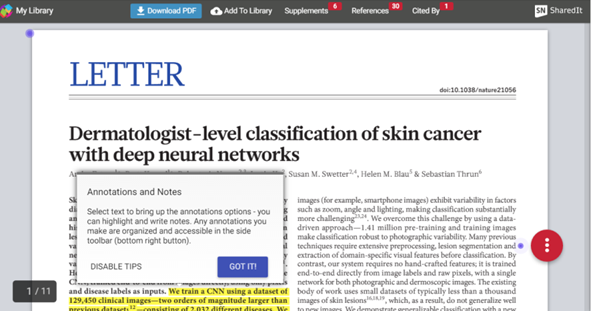
The project Springer Nature submitted to the Awards is SharedIt. SharedIt is a content-sharing initiative that provides links to view-only, full-text subscription research articles which can be posted anywhere - including on social media platforms, author websites and in institutional repositories – allowing researchers to share research, legally and freely, with colleagues and general audiences.

Tell us more about how it works and the team behind it


SharedIt uses technology provided by ReadCube, part of DigitalScience, to create a readable PDF version of the published paper – but one that cannot be downloaded – and creates a unique ‘SharedIt’ link which authors, and subscribers, can then forward on to other researchers.


Why do you think it demonstrates publishing innovation?


SharedIt is the first initiative by a global STM publisher to encourage authors to promote and use a free sharing facility – meaning anyone can access the published version of record if they have the SharedIt link. By not limiting the amount of times a paper can be shared this increases access to the published literature across the globe and through our own analysis we see many students and post-docs taking advantage of this sharing facility. Authors are also encouraged to share their links on social networking sites knowing that the research community will always have access to the final published version of record.


What are you plans for the future?


We plan to continue developing SharedIt and are currently trialling the use of sharing for books and book chapters. We are also looking into the use of SharedIt for our peer reviewer community. We are keen to listen to the community and expand SharedIt based on their needs and expectations around content sharing.

Sarah Greaves, PhD, is an experienced science publisher at the cutting edge of innovation and product development - having led successful journal launches and numerous other profitable projects in both traditional and new business models. During 18 years at Nature Publishing Group and now Springer Nature, Sarah has moved from being an editor at Nature Cell Biology, to the Nature publishing team; becoming the Nature publisher in 2007.


Since 2010 Sarah has focussed exclusively on innovation and new product launches and drove the launch of open access titles across Nature Publishing Group and has recently launched Recommended, a primary paper pan-publisher recommendation service across the Springer Nature platforms as well as helping to lead the SharedIt initiative.

www.springernature.com/sharedit
https://twitter.com/SpringerNature

See the ALPSP Awards for Innovation in Publishing Finalists lightning sessions at our Annual Conference on 13-15 September, where the winners will be announced. 

The ALPSP Awards for Innovation in Publishing 2017 are sponsored by MPS Ltd.


Monday, 21 August 2017

Spotlight on INASP - shortlisted for the 2017 ALPSP Awards for Innovation in Publishing

Author Aid LogoIn the third of our series of interviews with ALPSP Awards 2017 Finalists we talk to Andy Nobes, Programme Officer in the Research Development and Support team at INASP the people behind Author AID.


Tell us a bit about the work of INASP


INASP is an international development organization with the vision of research and knowledge at the heart of development. We work with partners in Africa, Latin America and Asia to support individuals and institutions to produce, share and use research and knowledge, which can transform lives.

Most research is published in the global North but many of the world’s most urgent problems are found in the global South. Early-career researchers in low- and middle-income countries face many challenges in communicating their work. These include: lack of familiarity with the global scholarly publishing landscape; lack of experienced colleagues who can advise them about publishing their work; inexperience of scientific writing; and often inexperience of writing in English. Other common challenges for researchers are: understanding plagiarism; choosing a suitable journal; and knowing the basic structure of a paper. They face all these challenges in addition to inherent biases in the global scholarly system, as well as particular challenges for female researchers and those from minority backgrounds or in fragile or conflict states.

Our AuthorAID project was started a decade ago to address these challenges. We work with partner institutions in Africa and Asia to embed research writing and proposal writing training into their curricula. The AuthorAID website also provides a free service for all researchers -  a database of free resources, an online discussion list, and a mentoring and collaboration platform. Over the last decade, our training has evolved from face-to-face training to online and blended courses, and most recently into our recent Massive Online Open Courses (MOOCs).


What is the project that you submitted for the Awards?


In 2015 AuthorAID launched a series of free research-writing MOOCs. These have been run twice-yearly on the Moodle open-source platform and have so far attracted nearly 7,500 researchers from over 100 developing countries. We have also run the course in Spanish in partnership with Latindex, training 3,000 researchers in Latin America. These courses are particularly good at supporting harder-to-reach groups, including female academics and those in fragile and conflict states. Such support is essential for ensuring equity in global research.

The course is six weeks long and covers four topics: literature review, research ethics, writing a paper and publishing in a journal.  Participants learn via text-based lessons, weekly quizzes, a facilitated discussion forum and peer-assessed writing activities, as well as optional short video content.


Tell us more about how it works and the team behind it


Caroline Koech, an environmental chemist in Kenya participating in the online course & carrying out laboratory analysis
Course participant Caroline Koech from Kenya
The AuthorAID team is small, and the MOOCs are run by just two core staff – I administrate and moderate the course from our Oxford office and my colleague Ravi Murugesan is the lead facilitator and Moodle expert, who is based in India. In order to manage groups of 1000+ course participants we rely on our team of volunteer ‘guest facilitators’. These are drawn from our global network of mentors and partner institutions, and we also promote ‘star’ participants to be facilitators on subsequent courses.

This facilitation model not only makes it possible to cater for large numbers of participants, across different time zones, but it also helps to pass on the skills to reduce the reliance on INASP. This is a key part of our sustainable development model.


Why do you think it demonstrates publishing innovation?


The innovation in our project is not so much in the technology – after all, MOOCs are becoming increasingly common in global education. Rather, it is the context, community and impact of the AuthorAID MOOCs that are uniquely innovative. Our courses are built on 10 years’ experience of training early-career researchers in developing countries, and our content is aimed at overcoming many of the practical problems that they face in publishing their research, such as writing skills and understanding the publishing process. The lessons are pitched at a basic, introductory level, presented in simple English.

The material is also designed to be used in low-bandwidth environments, as many of our audience have problems with access to reliable internet. The lessons are interactive text-based lessons rather than high-bandwidth video lectures which many participants find difficult to watch.  The strength of the course is in the interactive content and social interaction - the discussion forums, which are energised by our team of guest facilitators, are particularly active and we hear that many researchers make friends and research collaborators on the course.

The completion rate for the courses is around 50%, which is significantly higher than average MOOCs. Our courses include a high percentage (45%) of women researchers and we also reach participants in fragile and conflict-affected states, for example Afghanistan, Somalia, Iraq and Yemen.

Follow-up surveys have found that at least 34% of course participants have published papers after the course. Feedback has also shown increased confidence to publish, and increased awareness of important ethical issues like plagiarism and ‘predatory’ journals. We hear again and again from researchers about the difference that participating in an AuthorAID research-writi
ng MOOC has made to them, their academic careers, their colleagues, and their ability to share their research findings clearly with a wider audience.


Global map showing the geographical spread of the course and the concentration in developing countries.

What are your plans for the future?


We want to improve both the scope and delivery of our MOOCs – for example, we are translating the course into French, and developing a social science version. We are also creating additional content that is important to researchers – for example training in communicating research to the public, practitioners and policymakers. It’s becoming increasingly important to make online courses mobile-friendly, particularly in developing countries, and we are further developing content to be fully mobile optimised, including downloadable lessons and exercises that can be completed offline.

In the long term, INASP is currently looking at opportunities for further funding for this work to ensure that more early-career researchers in the developing world can continue to receive the training and support that they need so that they – and their research – can contribute to global research conversations.

Our ultimate goal is to make this training truly sustainable – not only by growing our network of online facilitators, but also working with some of our partner institutions around the world to run online courses in their own institutions. This training has already started with partners in Sri Lanka, Tanzania and Vietnam. We have also helped grant winners to trial their own mini-MOOC version of the course.

Photo of Andy Nobes
Andy Nobes
Andy Nobes is Programme Officer in the Research Development and Support Team at INASP. This involves the management of the AuthorAID website, and the development of its online mentoring scheme and community forums. 
Before joining INASP, he worked for an academic publisher in journal e-marketing and library marketing.


Twitter:  @INASPinfo and  @authoraid
Blog: blog.inasp.info    
Facebook: inasp.info   
YouTube: INASP   

See the ALPSP Awards for Innovation in Publishing Finalists lightning sessions at our Annual Conference on 13-15 September, where the winners will be announced.