Showing posts with label #alspawards17. Show all posts

Tuesday, 5 September 2017

Spotlight on Springer Nature SharedIt - shortlisted for the 2017 ALPSP Awards for Innovation in Publishing

In this blog we talk to Sarah Greaves of Springer Nature about their shortlisted entry to tell us the story behind SharedIt.


Tell us a bit about your company

Springer Nature was formed through the merger of Nature Publishing Group, Palgrave Macmillan, Macmillan Education and Springer Science+Business Media in 2015. It is a leading global research, educational and professional publisher, home to an array of respected and trusted brands providing quality content through a range of innovative products and services. The company numbers almost 13,000 staff in over 50 countries.

Our brands are some of the most trusted and respected in their fields, with Springer founded by Julius Springer in 1842, Nature first published in 1869 and Macmillan Education a leading publisher for over 150 years.

What is the project that you submitted for the Awards?


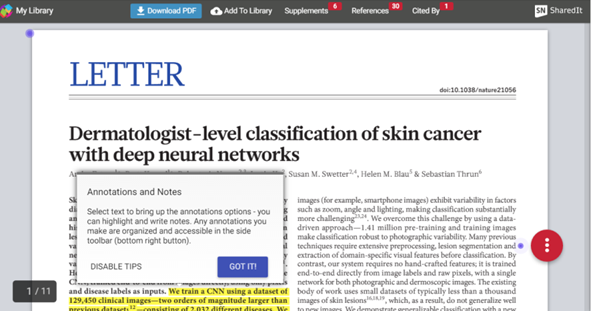
The project Springer Nature submitted to the Awards is SharedIt. SharedIt is a content-sharing initiative that provides links to view-only, full-text subscription research articles which can be posted anywhere - including on social media platforms, author websites and in institutional repositories – allowing researchers to share research, legally and freely, with colleagues and general audiences.

Tell us more about how it works and the team behind it


SharedIt uses technology provided by ReadCube, part of DigitalScience, to create a readable PDF version of the published paper – but one that cannot be downloaded – and creates a unique ‘SharedIt’ link which authors, and subscribers, can then forward on to other researchers.


Why do you think it demonstrates publishing innovation?


SharedIt is the first initiative by a global STM publisher to encourage authors to promote and use a free sharing facility – meaning anyone can access the published version of record if they have the SharedIt link. By not limiting the amount of times a paper can be shared this increases access to the published literature across the globe and through our own analysis we see many students and post-docs taking advantage of this sharing facility. Authors are also encouraged to share their links on social networking sites knowing that the research community will always have access to the final published version of record.


What are you plans for the future?


We plan to continue developing SharedIt and are currently trialling the use of sharing for books and book chapters. We are also looking into the use of SharedIt for our peer reviewer community. We are keen to listen to the community and expand SharedIt based on their needs and expectations around content sharing.

Sarah Greaves, PhD, is an experienced science publisher at the cutting edge of innovation and product development - having led successful journal launches and numerous other profitable projects in both traditional and new business models. During 18 years at Nature Publishing Group and now Springer Nature, Sarah has moved from being an editor at Nature Cell Biology, to the Nature publishing team; becoming the Nature publisher in 2007.


Since 2010 Sarah has focussed exclusively on innovation and new product launches and drove the launch of open access titles across Nature Publishing Group and has recently launched Recommended, a primary paper pan-publisher recommendation service across the Springer Nature platforms as well as helping to lead the SharedIt initiative.

www.springernature.com/sharedit
https://twitter.com/SpringerNature

See the ALPSP Awards for Innovation in Publishing Finalists lightning sessions at our Annual Conference on 13-15 September, where the winners will be announced. 

The ALPSP Awards for Innovation in Publishing 2017 are sponsored by MPS Ltd.


Monday, 21 August 2017

Spotlight on INASP - shortlisted for the 2017 ALPSP Awards for Innovation in Publishing

Author Aid LogoIn the third of our series of interviews with ALPSP Awards 2017 Finalists we talk to Andy Nobes, Programme Officer in the Research Development and Support team at INASP the people behind Author AID.


Tell us a bit about the work of INASP


INASP is an international development organization with the vision of research and knowledge at the heart of development. We work with partners in Africa, Latin America and Asia to support individuals and institutions to produce, share and use research and knowledge, which can transform lives.

Most research is published in the global North but many of the world’s most urgent problems are found in the global South. Early-career researchers in low- and middle-income countries face many challenges in communicating their work. These include: lack of familiarity with the global scholarly publishing landscape; lack of experienced colleagues who can advise them about publishing their work; inexperience of scientific writing; and often inexperience of writing in English. Other common challenges for researchers are: understanding plagiarism; choosing a suitable journal; and knowing the basic structure of a paper. They face all these challenges in addition to inherent biases in the global scholarly system, as well as particular challenges for female researchers and those from minority backgrounds or in fragile or conflict states.

Our AuthorAID project was started a decade ago to address these challenges. We work with partner institutions in Africa and Asia to embed research writing and proposal writing training into their curricula. The AuthorAID website also provides a free service for all researchers -  a database of free resources, an online discussion list, and a mentoring and collaboration platform. Over the last decade, our training has evolved from face-to-face training to online and blended courses, and most recently into our recent Massive Online Open Courses (MOOCs).


What is the project that you submitted for the Awards?


In 2015 AuthorAID launched a series of free research-writing MOOCs. These have been run twice-yearly on the Moodle open-source platform and have so far attracted nearly 7,500 researchers from over 100 developing countries. We have also run the course in Spanish in partnership with Latindex, training 3,000 researchers in Latin America. These courses are particularly good at supporting harder-to-reach groups, including female academics and those in fragile and conflict states. Such support is essential for ensuring equity in global research.

The course is six weeks long and covers four topics: literature review, research ethics, writing a paper and publishing in a journal.  Participants learn via text-based lessons, weekly quizzes, a facilitated discussion forum and peer-assessed writing activities, as well as optional short video content.


Tell us more about how it works and the team behind it


Caroline Koech, an environmental chemist in Kenya participating in the online course & carrying out laboratory analysis
Course participant Caroline Koech from Kenya
The AuthorAID team is small, and the MOOCs are run by just two core staff – I administrate and moderate the course from our Oxford office and my colleague Ravi Murugesan is the lead facilitator and Moodle expert, who is based in India. In order to manage groups of 1000+ course participants we rely on our team of volunteer ‘guest facilitators’. These are drawn from our global network of mentors and partner institutions, and we also promote ‘star’ participants to be facilitators on subsequent courses.

This facilitation model not only makes it possible to cater for large numbers of participants, across different time zones, but it also helps to pass on the skills to reduce the reliance on INASP. This is a key part of our sustainable development model.


Why do you think it demonstrates publishing innovation?


The innovation in our project is not so much in the technology – after all, MOOCs are becoming increasingly common in global education. Rather, it is the context, community and impact of the AuthorAID MOOCs that are uniquely innovative. Our courses are built on 10 years’ experience of training early-career researchers in developing countries, and our content is aimed at overcoming many of the practical problems that they face in publishing their research, such as writing skills and understanding the publishing process. The lessons are pitched at a basic, introductory level, presented in simple English.

The material is also designed to be used in low-bandwidth environments, as many of our audience have problems with access to reliable internet. The lessons are interactive text-based lessons rather than high-bandwidth video lectures which many participants find difficult to watch.  The strength of the course is in the interactive content and social interaction - the discussion forums, which are energised by our team of guest facilitators, are particularly active and we hear that many researchers make friends and research collaborators on the course.

The completion rate for the courses is around 50%, which is significantly higher than average MOOCs. Our courses include a high percentage (45%) of women researchers and we also reach participants in fragile and conflict-affected states, for example Afghanistan, Somalia, Iraq and Yemen.

Follow-up surveys have found that at least 34% of course participants have published papers after the course. Feedback has also shown increased confidence to publish, and increased awareness of important ethical issues like plagiarism and ‘predatory’ journals. We hear again and again from researchers about the difference that participating in an AuthorAID research-writi
ng MOOC has made to them, their academic careers, their colleagues, and their ability to share their research findings clearly with a wider audience.


Global map showing the geographical spread of the course and the concentration in developing countries.

What are your plans for the future?


We want to improve both the scope and delivery of our MOOCs – for example, we are translating the course into French, and developing a social science version. We are also creating additional content that is important to researchers – for example training in communicating research to the public, practitioners and policymakers. It’s becoming increasingly important to make online courses mobile-friendly, particularly in developing countries, and we are further developing content to be fully mobile optimised, including downloadable lessons and exercises that can be completed offline.

In the long term, INASP is currently looking at opportunities for further funding for this work to ensure that more early-career researchers in the developing world can continue to receive the training and support that they need so that they – and their research – can contribute to global research conversations.

Our ultimate goal is to make this training truly sustainable – not only by growing our network of online facilitators, but also working with some of our partner institutions around the world to run online courses in their own institutions. This training has already started with partners in Sri Lanka, Tanzania and Vietnam. We have also helped grant winners to trial their own mini-MOOC version of the course.

Photo of Andy Nobes
Andy Nobes
Andy Nobes is Programme Officer in the Research Development and Support Team at INASP. This involves the management of the AuthorAID website, and the development of its online mentoring scheme and community forums. 
Before joining INASP, he worked for an academic publisher in journal e-marketing and library marketing.


Twitter:  @INASPinfo and  @authoraid
Blog: blog.inasp.info    
Facebook: inasp.info   
YouTube: INASP   

See the ALPSP Awards for Innovation in Publishing Finalists lightning sessions at our Annual Conference on 13-15 September, where the winners will be announced.