Showing posts with label #alpsp17. Show all posts

Thursday, 19 July 2018

Business Models for Open Access: How can I run a successful Open Access journal?


JAMS logo

In this week's guest blog Martyn Rittman, Ph.D, Publishing Services Manager at MDPI, offers some words of wisdom for developing successful open access journals.


The Directory of Open Access Journals contains over 11,500 journals and more than 3.1 million open access articles. Our indexing database Scilit contains around 20 million freely available articles, mostly open access. Estimates put the amount of open access in the region of 15% to 20% of all published articles. Do these numbers represent a threat to traditional revenue channels, or is it possible to run a healthy business using this model?

MDPI started publishing free online articles in the late 1990s. At first, we were supported by other projects, conferences, grants, and a great deal of voluntary time. In the mid-2000s, along with other publishers, we adopted author-side charges for publication, commonly known as article processing charges (APCs). By separating the journal editors making final acceptance decisions from the publisher, we have been able to maintain a rigorous and objective peer review process alongside gold open access. However, we have spoken to other publishers who have found it difficult to adopt the open access model, don’t feel they have the expertise, or find it difficult to cover their costs. Here, we offer some advice for developing successful open access journals.


Sources of revenue

Assure yourself that revenue streams for open access are available, even in fields with high scepticism towards author-side charges.  An increasing number of national funding agencies and governments have open access mandates, and offer support for the payment of APCs. National agreements with publishers are also emerging. Many non-governmental funding agencies and university libraries have also embraced open access and provide assistance to authors. These include the Wellcome Trust, the European Union, the Bill and Melinda Gates Foundation, and many more. A useful resource to see the amounts paid by universities for open access publication is the OpenAPC platform (https://treemaps.intact-project.org/apcdata/openapc/). Other models include Knowledge Unlatched for humanities and SCOAP3 for high energy physics, where publishers receive a per-article payment out of a central fund collected from funders and libraries. Smaller journals may be able to find a single funding agency, university or society to cover all the costs of the journal, especially in niche fields. In fact, there are increasing opportunities that do not involve directly invoicing authors.

Providing a useful service

Do not assume that open access is enough. Look carefully at the scope of your journal to see whether it offers something unique in the field. This is especially critical for new journals. For many authors, the decision on where to publish is not primarily linked to open access: the scope, editorial board, and reputation of the journal are usually more important. Open access journals should be focused on providing a good service to authors and you can distinguish your journal simply by providing a better alternative to existing journals.

Workflows

Consider new workflows for your journal. There may be an initial cost to making changes in how you run the journal but it will pay off in the long-term. Authors publishing in open access are often looking for a quick decision and publication. This might mean revisiting how editorial decisions are made, and changing expectations among editors, editorial board members and reviewers about how quickly they provide feedback. On the marketing side, you will need to consider how to better reach your target authors, redirecting efforts from potential subscription customers. If you opt for an APC model, handling a larger volume of small payments may require a new approach to invoicing.

There is no magic formula for running an open access journal and much of the work is the same as for traditional journals. Open access journals now exist in all fields using all kinds of editorial and business models. At MDPI, we continue to see growth in the open access market across many research fields. We are convinced of the benefits of universal access through a large, broad readership, allowing ideas to shape those outside of the academy as well as authors from institutions with small subscription budgets. Open access supports the dissemination and sustainability of knowledge and we encourage all publishers to take advantage.

Head and shoulders photo of Martyn Rittman
Martyn Rittman, Ph.D. is Publishing Services Manager at MDPI, combining a passion for open access publishing with an interest in new models for publishing and open science. He joined MDPI in 2013 following a research career covering physical chemistry, materials science, instrumentation, and mathematical modelling.


MDPI is headquartered in Basel, Switzerland, with branch offices in China, Spain, and Serbia. It runs over 200 fully open access journals, including some in collaboration with scholarly societies, and in 2017 published over 35,000 peer-reviewed articles. MDPI also provides publisher services through its JAMS software (jams.pub) and offers academic communication tools, including a conference management platform, at sciforum.net.

JAMS website: http://jams.pub
MDPI website: http://www.mdpi.com/publishing_services
Twitter: https://twitter.com/MDPIOpenAccess
Facebook: https://www.facebook.com/MDPIOpenAccessPublishing/


MDPI are proud silver sponsors of the ALPSP Annual Conference and Awards 2018


Thursday, 5 October 2017

Breaking Down Barriers in Scholarly Publishing

In this ALPSP guest blog, Craig Griffin, Solutions Engineer at Silverchair Information Systems discusses a two-prong strategy to help scholarly publishers optimize the use and functionality of their content.


We in scholarly publishing have visions of a future powered by Artificial Intelligence. Self-learning applications. Powerful discovery techniques. Machine-based learning tools. Change is a constant in any industry, but the rate of change within scholarly publishing is increasing rapidly on all fronts.  Journals and books, long the bread and butter of publishers, have now been joined by an explosion of additional content types such as video, data sets, grey literature, and learning formats.  Optimizing the use and functionality of this content in light of researchers’ needs to author, publish, and discover highly varied content sets alone presents a challenge.

A second challenge is found in the sheer volume of content being pushed through ever greater numbers of channels.  Discovery of content, regardless of channel, occurs off-platform on the servers of Google, PubMed, Crossref, or any number of social media platforms that no publisher, society, or author controls. With content in myriad formats and fractured delivery channels, it’s challenging for even the most capable power-user to be sure that their research is exhaustive or to stay on top of the latest developments.

A solution to this problem involves a two-prong strategy.

First, publishers need to Standardize the entire content set. Of course, content formats have evolved over the years, sometimes in a prescribed, documented evolution, and other times completely organically.  Since the software to display this content needs to handle all these variations, the content itself then becomes monolithic—it works in this one specific way, with this software layer above it, but does not function correctly outside of the content structure/software pair. It’s completely locked in its database.

Standardized formats allow content to reside in a more efficient database.  With a clearly defined data and database structure, the software layer above can extract and display information across content eras and handle associations easily.  Standardization also allows content types to be related in a far more efficient and flexible manner.  A video and a journal article, for example, with separate but standard structures can be related via metadata, content elements, or any other association desired by the publisher.  Additionally, Standardized content becomes much more accessible to machines, which as of now are the primary consumer of content. This can be via discovery bots, search engine crawlers, or Text and Data Mining apparatuses.  The rate and volume of these automated tools is the only true match to the explosion of content.

Once Standardized, publishers can then deploy the second strategy:  Breaking Down Silos.  This is achieved by bringing all the Standardized content—of any type—into a single platform. Once the unification of content has occurred, with discovery, display, relational associations, and third-party linkages all coming from one technology stack, content can then become substantially more functional for the end-user.  Content can then be organized by editorial concepts rather than simply by types or titles.  By improving the organizational options of standardized content, publishers can then tailor (and sell) collections targeted at infinitely narrower user groups.  This achieves the direct benefit of presenting specific content to a user at the exact moment of need.

It’s important for publishers to think of the user’s journey to their content (via any number of discovery methods): think of the user’s purpose in accessing the content. Although AI tools have begun the work of meeting the user at the right moment on their path, publishers can accelerate this process to the benefit of both their audience and their bottom line. By following the strategies of Standardization and Breaking Down Silos, users will be rewarded with an experience that works for them, rather than solely for the content.

About Silverchair: Silverchair integrates and delivers scholarly and professional content from a single platform – journals, books, video, custom formats, and more. The Silverchair Platform delivers advanced semantic technologies and publishing platforms to STM and humanities publishers, professional societies, and the federal government. We collaborate with publishers to propel their content to greater reach and impact.


Silverchair is a proud Silver Sponsor of the ALPSP 2017 Annual Conference. Hear from Chief Product Officer, Jake Zarnegar on his takeaways from the ALPSP conference in this insightful video blog.


Friday, 8 September 2017

Spotlight on SourceData - shortlisted for the 2017 ALPSP Awards for Innovation in Publishing


Last but not least in our series of blogs on our 2017 Awards Finalists is EMBO – the creators of SourceData. We speak to Project Leader Thomas Lemberger to find out more:

Tell us a bit about your organisation


EMBO is an international organization that promotes scientific excellence in Life Sciences.It has over 1700 members elected from the leading researchers of Europe and beyond. The organization is funded by 29 member states to provide support to scientists through events, networking opportunities, funding and fellowships for young researchers and shaping science policy. EMBO also publishes four journals reporting important discoveries from the global bioscience community: EMBO Journal, EMBO Reports, Molecular Systems Biology and EMBO Molecular Medicine.

What is the project that you submitted for the Awards?


SourceData is a technology platform made up of several tools that extract information about published figures and make scientific data more discoverable.Through EMBO’s work at the intersection of research and publishing we realized there is a disconnect between the way research data is published in scientific papers and the way researchers typically want to interact with it.  Most scientific papers report the results of carefully-designed experiments producing well-structured data. Unfortunately, during the publishing process this data is typically summarised in text and graphs and “flattened down” thus losing a lot of valuable information along the way.   As a result, it can be very difficult for researchers to find answers to relatively simple questions because data is inaccessible.

For example, it is currently very cumbersome for a scientist to find specific experiments where a certain small molecule drug has been tested on a specific cancer cell line or to look at the results of a published experiment and find out whether similar data had been published elsewhere. These are the kinds of scenario where SourceData can help. SourceData goes to the heart of the scientific paper - the data - and extracts its description in a usable format that researchers can access and interrogate. It then goes on to link this data to results from other scientific papers that have been through the same process.


SourceData - Making Scientific Data Discoverable from SourceData on Vimeo.
 

Tell us more about how it works and the team behind it


With SourceData, EMBO has developed a way to represent the structure of experiments. The principle of SourceData is rather simple: we identify the biological objects that are involved in the experiment and then we specify which objects were measured to produce the data and which, if any, were experimentally manipulated by the researchers. Despite its apparent simplicity, this method allows us to build a scientific knowledge graph that turns out to be a very powerful tool for searching and linking papers and their data.

The development of SourceData has been a collaborative process involving the Swiss Institute of Bioinformatics who provided their expertise in developing software platforms in the field of Life Sciences and the curation of data.  After this we worked with Wiley to implement SourceData within a publishing environment. Nature also contributed content to the initiative.

Why do you think it demonstrates publishing innovation?


SourceData transforms the way that researchers can interact with scientific papers by getting to the heart of the paper - the data, and putting it into a highly searchable form. It then takes this a step further by linking this data with relevant results from other scientific papers so that researchers can explore these connections.SourceData can give readers a new level of confidence in finding more of the research that is relevant to their questions. It can give scientists more opportunities to have their publications found and cited and can allow publishers to expose more of their content to interested readers by making it even easier to search and explore.

What are your plans for the future?


Our work to date has involved a lot of manual work so we are now working to automate this process. We are developing artificial intelligence algorithms using deep learning to extract the structure of an experiment from their descriptions in natural language.  Our vision is to provide access to our technology to as many publishers as possible and encourage the widespread adoption of SourceData. In doing so we hope to facilitate access to the data behind more and more journals over time and ultimately accelerate Science in the process.


Thomas Lemberger is leading the SourceData project and is passionate about the importance of scientific data and structured knowledge in publishing. Trained as a molecular biologist, Thomas is Deputy Head of Scientific Publications at EMBO and Chief Editor of the open access journal Molecular Systems Biology.

Twitter: https://twitter.com/embocomm
Facebook: https://www.facebook.com/EMBO.excellence.in.life.sciences

See the ALPSP Awards for Innovation in Publishing Finalists lightning sessions at our Annual Conference on 13-15 September, where the winners will be announced. 

The ALPSP Awards for Innovation in Publishing 2017 are sponsored by MPS Ltd.


Wednesday, 6 September 2017

Spotlight on Escalex - shortlisted for the 2017 ALPSP Awards for Innovation in Publishing


Escalex LogoIn the third of our series on our Awards finalists we catch up with Rhianna Jones to hear about Escalex. 


Tell us a bit about your company


Escalex is a joint venture by two companies, Molecular Connections and IFIS Publishing.

Molecular Connections is a leading supplier of manually curated databases and informatics solutions to major pharmaceuticals, high throughput data analysts and systems biology companies across the globe.

IFIS Publishing is a global, not-for-profit information provider in the sciences of food and health. IFIS publishes FSTA, a comprehensive database of scientific and technological research and information relating to food, beverages, and nutrition.

What is the project that you submitted for the Awards?


We submitted Escalex, a one-stop knowledgebase for authoritative regulatory information on food and drink.

To give some background, Escalex came out of discussions with the academic and industry food communities. We kept hearing how difficult and time-consuming it was to find essential food regulatory information and keep-to-date with changes. Food law is a very complex area. Even within one country, regulations can be managed by a range of government departments, with information stored in different places and with varying levels of standardisation. When you need information across multiple geographies, it becomes even more challenging.

Furthermore, many regulatory documents are hundreds of pages long. A frequent pain point was that even when one has the right document, it can still take a long time to find a specific piece of information within it.

IFIS and Molecular Connections recognised that together we could make a real difference in this area. After three years of research, development and testing, we launched Escalex in April 2017.


Tell us more about how it works and the team behind it


Escalex's strength comes from the combination of IFIS' expertise in managing complex scientific food and beverage information, and Molecular Connections' innovative information discovery and mining capabilities.

For example, we discovered that throughout food regulations globally, there is no standardised format or categorisation of the themes for regulatory documents. As part of Escalex’s development, in-house experts in food law and food science created categories and subcategories for deep-indexing the content, which have been specifically designed for optimum granularity.


Escalex screenshot
With a user-friendly interface and dedicated search lenses, Escalex facilitates multiple ways to navigate content, including tabulated data. Every record is indexed in-depth using a commodity-based and regulations-enriched thesaurus, which enables high granularity of search results.  


Why do you think it demonstrates publishing innovation?

From our research, it was clear that there was no solution available that met the complex information needs of the community.

Escalex was built from scratch using real-life use cases, resulting in an efficient research tool to mine and digest food regulation content.

We recognise that every user is different. Some like to browse, others like keyword searching. Some will be experts in food law, others will be beginners. Some people will want the full, original document, while others will want a snippet. We developed Escalex with this in mind, providing users with a choice of routes into the regulatory information: Dashboard, Explore, Limits, Definitions and Documents. Escalex also provides annotated, bookmarked versions to make the full documents easier to navigate.

Escalex screenshotWe have also designed Escalex to point users in the direction of additional relevant information that they may not have been aware of, such as related documents, validity dates to help manage transitional periods, and the option to open up an easy follow on search in another lens.

These are just a few examples of innovation within Escalex, aiming to make food law research easier and more effective.


What are your plans for the future?


We have an exciting development roadmap in place. In line with feedback from the community, we are currently working on Brazil, India, Malaysia and Singapore as the next countries to be added, as well as GRAS reports and US state level regulations.

We also have lots of ideas for additional functionalities, so Escalex is going to be keeping us all busy for the foreseeable future!

Rhianna Jones
Rhianna Jones is Senior Marketing Manager at IFIS Publishing, and an active volunteer with the Special Libraries Association and Institute of Food Technologists, British Section.

Website: https://www.escalex.org/
Twitter: IFIS Publishing – http://www.twitter.com/IFIS_foodinfo
Molecular Connections – http://www.twitter.com/MC_InnoHub
 

See the ALPSP Awards for Innovation in Publishing Finalists lightning sessions at our Annual Conference on 13-15 September, where the winners will be announced. 

The ALPSP Awards for Innovation in Publishing 2017 are sponsored by MPS Ltd.


Tuesday, 5 September 2017

Spotlight on Springer Nature SharedIt - shortlisted for the 2017 ALPSP Awards for Innovation in Publishing

In this blog we talk to Sarah Greaves of Springer Nature about their shortlisted entry to tell us the story behind SharedIt.


Tell us a bit about your company

Springer Nature was formed through the merger of Nature Publishing Group, Palgrave Macmillan, Macmillan Education and Springer Science+Business Media in 2015. It is a leading global research, educational and professional publisher, home to an array of respected and trusted brands providing quality content through a range of innovative products and services. The company numbers almost 13,000 staff in over 50 countries.

Our brands are some of the most trusted and respected in their fields, with Springer founded by Julius Springer in 1842, Nature first published in 1869 and Macmillan Education a leading publisher for over 150 years.

What is the project that you submitted for the Awards?


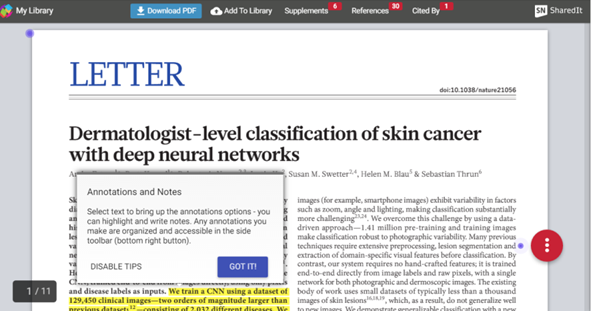
The project Springer Nature submitted to the Awards is SharedIt. SharedIt is a content-sharing initiative that provides links to view-only, full-text subscription research articles which can be posted anywhere - including on social media platforms, author websites and in institutional repositories – allowing researchers to share research, legally and freely, with colleagues and general audiences.

Tell us more about how it works and the team behind it


SharedIt uses technology provided by ReadCube, part of DigitalScience, to create a readable PDF version of the published paper – but one that cannot be downloaded – and creates a unique ‘SharedIt’ link which authors, and subscribers, can then forward on to other researchers.


Why do you think it demonstrates publishing innovation?


SharedIt is the first initiative by a global STM publisher to encourage authors to promote and use a free sharing facility – meaning anyone can access the published version of record if they have the SharedIt link. By not limiting the amount of times a paper can be shared this increases access to the published literature across the globe and through our own analysis we see many students and post-docs taking advantage of this sharing facility. Authors are also encouraged to share their links on social networking sites knowing that the research community will always have access to the final published version of record.


What are you plans for the future?


We plan to continue developing SharedIt and are currently trialling the use of sharing for books and book chapters. We are also looking into the use of SharedIt for our peer reviewer community. We are keen to listen to the community and expand SharedIt based on their needs and expectations around content sharing.

Sarah Greaves, PhD, is an experienced science publisher at the cutting edge of innovation and product development - having led successful journal launches and numerous other profitable projects in both traditional and new business models. During 18 years at Nature Publishing Group and now Springer Nature, Sarah has moved from being an editor at Nature Cell Biology, to the Nature publishing team; becoming the Nature publisher in 2007.


Since 2010 Sarah has focussed exclusively on innovation and new product launches and drove the launch of open access titles across Nature Publishing Group and has recently launched Recommended, a primary paper pan-publisher recommendation service across the Springer Nature platforms as well as helping to lead the SharedIt initiative.

www.springernature.com/sharedit
https://twitter.com/SpringerNature

See the ALPSP Awards for Innovation in Publishing Finalists lightning sessions at our Annual Conference on 13-15 September, where the winners will be announced. 

The ALPSP Awards for Innovation in Publishing 2017 are sponsored by MPS Ltd.


Wednesday, 23 August 2017

Spotlight on Delta Think - shortlisted for the 2017 ALPSP Awards for Innovation in Publishing


In the second of our series of interviews with our ALPSP awards finalists we talk to Ann Michael, President of Delta Think.

·         Tell us a bit about your company

Delta Think is a business and technology consulting firm focused on innovation and growth in scholarly publishers and membership organizations. Founded at the height of the transition from print to digital, our core purpose is helping organizations to manage change. We live at the intersection of content, technology and user experience, and help our clients through the many changes impacting scholarly publishers and membership organizations.

·         What is the project that you submitted for the Awards?

The Delta Think Open Access Data & Analytics Tool  (OA DAT) is a living compilation of industry data, anonymized private data and analysis, which provides a comprehensive view of the OA market.

The idea originated with questions arising during consulting engagements. We found commonality in questions clients asked about OA, with no clear consolidated, reliable data source to address them. We saw an opportunity to serve the industry more effectively by curating such a data set, and supplementing it with analysis, commentary, and visualizations.


·         Tell us more about how it works and the team behind it

The OA DAT includes several levels of analysis and data access to accommodate any organization’s available bandwidth, comfort level with data analytics, and budget. We’ve worked hard to build a consistent view of the market and to make existing silos of data interoperate to deliver new insights, supplementing them with publisher confidential data (de-identified and aggregated).

The tool includes interactive visualizations so users can extract meaning for real-world decision-making, while providing a quick way to tailor the tool to areas of interest with a few mouse clicks. There is a sample interactive visualization and a brief video on our website , and a few static images below.

Additionally, we curate and aggregate OA industry news and combine it with a short analysis to publish Delta Think’s OA News & Views, which is available free of charge with registration.

We launched the Delta Think Open Access Data & Analytics Tool in beta to pre-launch subscribers in December of 2016, with our full launch in January of 2017. The tool is continually updated. To keep the product current and the user base growing, we work with two core data analysts (one with deep database experience), a research associate, product manager, project manager, marketer, and a business development resource
© 2017 Delta Think, Inc. All rights reserved. May not be reused without permission

·         Why do you think it demonstrates publishing innovation?

We had two key motivations in developing the tool: generally increasing industry data proficiency, and specifically supporting organizations as they make data driven strategic and ongoing decisions around Open Access. While several organizations have the bandwidth and budget to develop data analytics expertise, most find using data in decision making aspirational and, at best, episodic. It is not a part of their normal workflow.

On one level, our innovation is pulling disparate information together and continually updating it to provide benchmarks and genuinely novel insights into the Open Access market.

But the innovation goes much deeper: In a single product, we have created the means for any organization to use data in OA decision making on an ongoing basis.
·       Organizations not equipped to interact with the underlying data can read the analysis and benefit from its regular updates. They don’t have to wait a year or two for an analyst report to be refreshed.
·       Organizations looking to interact with the data can manipulate visualizations, narrowing in on elements important to them (e.g., geographic region, subspecialty, year, etc.).
·       Organizations equipped to gather, normalize, and analyze data and knowing the questions they want answered can export OA DAT data, combine it with proprietary data, and complete their own analyses. They can also use OA DAT to save time and effort in data collection, allowing them to focus more on their proprietary analysis.
·        For any of the above, our consulting resources support targeted research or produce custom reports.
The tool is valuable and accessible to the expert or the novice.

·         What are your plans for the future?

We currently focus on STM + Social Science, OA, Journals, as well as not-for-profit and commercial publishers. We plan to extend product coverage to books, open data, and even overall scholarly output (overlaying analytics on top of the usual indexes). We also plan to extend to institutional markets (both librarians and research departments) and other industry players interested in Open Access. Additionally, we are in confidential discussions with many potential data and tech partners.

Our bigger picture goal is to create extensions to the Delta Think Open Access Data Analytics Tool and develop other products or services supporting scholarly publishers, membership organizations, and the multitude of players in the scholarly communications ecosystem to build data and business analytics into their culture and their workflows.

photo Ann MIchaelAnn Michael is President of Delta Think, a business and technology consulting and advisory firm focused on innovation and growth in membership organizations and scholarly publishers. Ann is a Past President of the Society for Scholarly Publishing (SSP), an NFAIS board member, a Board Director at Joule (a Canadian Medical Association company), a frequent organizer and speaker at industry conferences, and is a contributor to the SSP’s blog, The Scholarly Kitchen. 

Twitter: @deltathink @annmichael
LinkedIn: https://www.linkedin.com/in/annmichael
LinkedIn:  https://www.linkedin.com/company/delta-think
Facebook:  facebook.com/deltathink


See the ALPSP Awards for Innovation in Publishing Finalists lightning sessions at our Annual Conference on 13-15 September, where the winners will be announced. 

The ALPSP Awards for Innovation in Publishing 2017 are sponsored by MPS Ltd.